by Ümit Akçay
Translated from Turkish daily evrensel.net (12 July 2026)
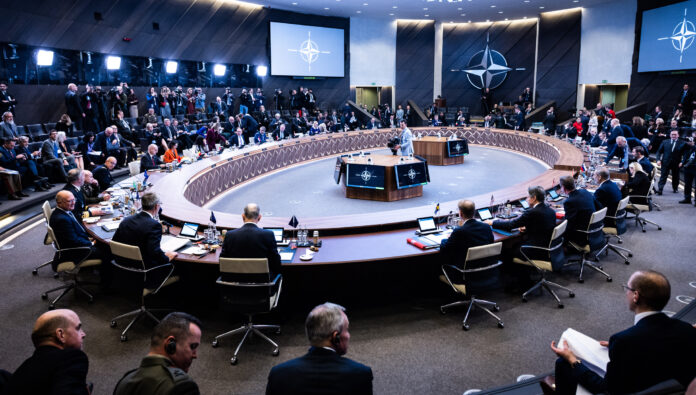
At first glance, the NATO summit in Ankara revolves around the usual security issues: Russia, Ukraine, Iran, and the future of the Atlantic Alliance. However, the real issue behind the summit concerns less security and more international political economy. Who will finance the West’s military power? Who will manufacture the weapons? Who will hold strategic leadership? Which societal groups will bear the costs of this transformation?
The new order that emerges from these questions could be called “NATO 3.0”. In my post this week, I addressed this new order.
Dealing with the relative decline of the USA
The relative decline of US hegemony has long been a subject of debate. The US still possesses financial and military superiority. The dollar remains the primary international reserve currency. The US Federal Reserve retains its role as the final authority for global dollar liquidity. American financial markets, payment systems, and military capabilities continue to be cornerstones of the international order.
While the US retains its financial and military superiority, its post-World War II manufacturing lead has largely diminished. The centre of global manufacturing has shifted to East Asia, particularly to China.
This contradiction accelerates a process that could be described as “imperialism as hierarchy management .” This involves the reorganization of trade, finance, technology, and security institutions to restore American primacy, while US superiority in manufacturing diminishes.
Tariffs, technology restrictions, industrial subsidies, financial sanctions, and military alliances are the complementary instruments of this strategy. These instruments are used to bring allies into line, restrict competitors, restructure supply chains, and secure control over the most profitable sectors of the global economy.
This is therefore not simply the end of globalization. Rather, it is about a selective reshaping of international relations based on mutual dependence, in line with US strategic priorities.
The US national security strategy for 2025 also makes this logic clear. European allies are expected to assume a greater share of the security burden in their respective regions and to align their trade, technology, and defence policies more closely with Washington.
NATO 3.0 forms the military part of this broader geo-economic project.
From NATO 1.0 to NATO 3.0
NATO 1.0 was the alliance of the Cold War era. It was focused on the “Soviet threat,” the territorial defence of Europe, and the permanent leadership role of the USA on the continent. On the one hand, it institutionalized the American military presence; on the other hand, it integrated the rearmament of West Germany into the Atlantic command structure.
NATO 2.0 emerged after the collapse of the Soviet Union. The alliance expanded eastward and evolved into an instrument for military interventions, counterterrorism, and crisis management beyond its original borders. The Balkan states, Afghanistan, and Libya were the key areas of operation that characterized this phase.
When the war broke out in Ukraine, the post-Cold War European security order had entered an open military crisis.
“NATO 3.0,” on the other hand, represents a new transformation. Europe is expected to assume greater responsibility for the continent’s conventional defense. The aim is to encourage the US to focus its military and strategic resources on Asia—or, to put it more bluntly, on competing with China.
This process is referred to as the “Europeanization” of NATO. However, this should not be confused with the strategic autonomy of Europe.
Europe’s responsibility is increasing, but its strategic independence is not growing at the same rate. European countries will provide more soldiers, weapons, and financial resources. In return, the nuclear umbrella, crucial technological superiority, and overall strategic leadership will remain in the hands of the United States.
This means that Europe is not breaking away from the American security system. It is being assigned a more costly role within this system.
Rearmament as an economic policy measure
The financial basis of NATO 3.0 is the goal of increasing defence and security spending to 5 percent of gross domestic product by 2035. Of this, 3.5 percent is to be earmarked directly for military expenditures. The remaining 1.5 percent can be allocated to areas such as infrastructure, cybersecurity, resilience, and the promotion of the defence industry.
This means more for Europe than just a simple target for defence spending – it means a new financial order.
German economies in particular, but also those of other European countries, have long faced stagnation, weak investment, and the pressures of deindustrialization. Under these circumstances, rearmament is presented as a possible economic solution.
Military spending generates industrial contracts, promotes investment, and increases employment in the defence sector. For countries like Germany and France, which have large arms manufacturers, this amounts to a kind of military Keynesianism.
However, the composition of public spending is important. The funds spent on missiles, drones, surveillance systems, and munitions do not flow into social housing, healthcare, education, or a socially just green transition.
This also reveals the class-based nature of the new spending regime. Arms companies receive state-guaranteed contracts. Investors secure protected sources of income. A significant portion of the economic risks, however, is borne by the public sector.
Financial rules that are considered sacrosanct in discussions about social investments suddenly become flexible when it comes to arms production. Government borrowing is once again seen as legitimate not for meeting social needs, but for financing rearmament.
The costs of this transformation will not be evenly distributed. In Europe, there will be further cuts to workers’ social rights, while in Turkey, the authoritarian regime’s wage-pressure policies against the working class will intensify. It is not difficult to imagine the political implications. The more workers are asked to sacrifice their standard of living for the sake of military expansion, the deeper the legitimacy crisis of the centrist parties will become.
For this reason, NATO 3.0 is also a class-based project. The restructuring of public budgets to meet the needs of arms production, while simultaneously shifting the costs downwards to the working classes, is part of how this project functions.
Turkey aims for a higher position
From the perspective of the ruling bloc in Turkey, the summit in Ankara offers an opportunity to transform geopolitical significance into a strategy of capital accumulation.
Turkey no longer wants to be seen merely as an “outpost” on NATO’s southeastern flank. It aspires to become one of the most important centres for logistics and the defence industry, connecting the Black Sea, the eastern Mediterranean, and the Middle East.
NATO’s ammunition shortages and its efforts to expand military production capacities increase the importance of those countries that can produce drones, armoured vehicles, missiles and conventional weapons on a large scale.
The defence industry forum held as part of the Ankara Summit also focused on joint procurement, cooperation between the military and industry, and the expansion of production capacities. Ankara is also seeking to lift restrictions on defence companies and regain access to advanced Western arms programs.
This strategy has a clear domestic political and economic dimension. Arms production generates export revenues, government contracts, an increase in technological capacity, and new opportunities for state-sponsored corporate groups.
At the same time, the Presidential Office strengthens ties between the military bureaucracy and defense capital, which has strong political connections. Industrial policy fuels the nationalist narrative that military power and political sovereignty are mutually reinforcing.
However, this strategy has not eliminated the dependency. Turkey is attempting to strengthen its position within a hierarchical military-industrial value chain in which the most advanced technologies, financing structures, and strategic decisions are concentrated in the US and Western Europe.
The new version of the Ismay formula
The first Secretary General of NATO, Lord Ismay, summarized the alliance’s goal at the time with his famous phrase: “Keep the Russians out, the Americans in, and the Germans down.”
NATO 3.0 updates this formula.
Russia is still seen as a power that must be contained. The US retains strategic leadership. However, Germany and the rest of Europe are no longer merely to be kept under control. They are expected to take out loans, rearm, and produce – provided they remain within the US-led security architecture.
Turkey, on the other hand, aims to become one of the alliance’s most important production and logistics centres.
The international political economy of “NATO 3.0” can be summarized as follows: Europe will pay more, arms manufacturers will earn more, Turkey will try to obtain a larger share of new arms contracts, and the US will gain more room to focus on China.
In this sense, the summit in Ankara enshrines the new strategy that the US has developed to cope with its relative decline.
In short: NATO 3.0 aims to transform stagnation in Europe into militarism, dependence on the alliance into burden-sharing, and societal resources into the foundations of a permanent war economy.