by Arif Koşar
Translated from Turkish daily evrensel.net (13 July 2026)
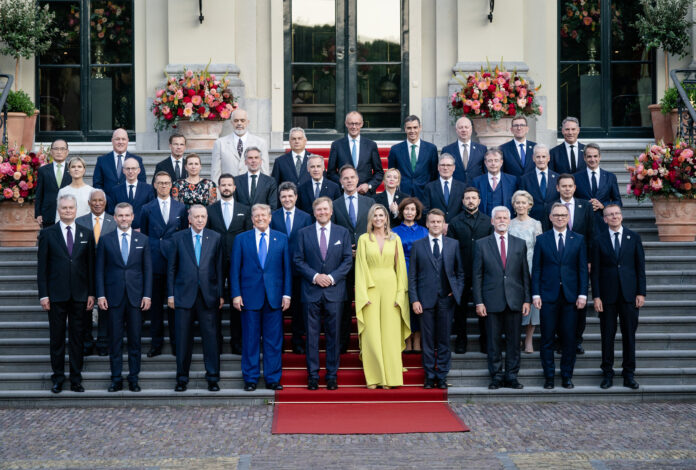
There was much discussion and talk about the defence spending budget, defence industry contracts, Trump’s comments about Pastor Brunson, Ukraine, the Janissaries, strange gifts, and the menu…
However, what lies behind these images, and perhaps receives little attention precisely because it has almost become normal, is the following: At the NATO summit in Ankara, the word “war” was loudly shouted.
It has been announced that the defence industry will be restructured using artificial intelligence technologies.
The measures to achieve the previously agreed goal of increasing the defence spending of European economies to 5 percent of their GDP were welcomed.
During the summit held in Ankara, arms procurement contracts with a total value of $50 billion were concluded at the Defence Industry Forum.
The roar
NATO Secretary General Rutte, who spoke with pleasure about these agreements, also called for more speed and concrete results: “The hum of the machines must now become a roar.”
Who is this roar directed against?
The explicit target, as is clearly stated in the summit’s final document, is Russia.
The unstated, yet equally obvious target is China.
According to US Defense Secretary Pete Hegseth, NATO must now be a “real military alliance focused on strong power and real deterrence”.
As NATO spokespeople explained, an era has come to an end. NATO 2.0, which after the collapse of the Soviet Union was considered without an enemy and inoperative, and whose existence was fortunately secured by the invention of an enemy like “global terrorism,” has now become obsolete. The enemy is clear… With NATO 3.0, what is already known begins: a new cold, perhaps even hot, war.
One of the characteristic features of this new era and this new beginning is the greater integration of the defence industry into artificial intelligence systems.
Digital-military-industrial complex
One of the core elements of this new beginning, as stated in the final declaration of the Ankara summit, is the “transatlantic war cloud” and the “introduction of powerful AI models”.
NATO adopted its first AI strategy in 2021 and updated it at the 2024 summit in Washington in light of developments in generative AI technologies. Furthermore, the Defence Innovation Accelerator for the North Atlantic (DIANA) programme promotes initiatives in artificial intelligence, autonomous weapons, and cybersecurity. The NATO Innovation Fund also provides financial support for these initiatives.
The ongoing integration of AI models into the defence industry is paving the way for changes that go beyond a mere technical update: the integration of technology companies into the military-industrial complex of NATO and the US, which play a crucial role within NATO. This is creating a kind of digital-military-industrial complex.
We recently witnessed one of the measures employed by this complex. The intelligent system “Maven” (Project Maven), which “directed” the US attack on Iran, illustrates the rupture caused by the involvement of technology companies in the military-industrial complex. Maven is a multifaceted digital-military system led by Palantir, but also including leading technology companies such as Amazon, Anthropic, META, and OpenAI. The system processes millions of data points from spy satellites, drones, ground-based radar, and intelligence agents on the ground, identifying potential targets and the weapons and ammunition that can be used to destroy them. Using this system, more than a thousand targets in Iran were struck in the first 24 hours. However, at least one of these targets was incorrect: the ” Shajareh-i Tayyibah ” primary school in the Iranian city of Minab was also on the target list, and 185 people, mostly children, were killed.
The race of technology companies
The connection between technology companies and military equipment is nothing new.
In fact, many technologies that we use in everyday life today – such as the internet or facial recognition – were developed with military means and for military purposes.
Unlike defence contractors, technology companies had long grown primarily not through government contracts, but through the commercial products they brought to market. Despite military support, Silicon Valley had defined itself as a liberal space committed to the well-being of humanity.
Now, the world’s most popular, respected, and highly praised technology companies and corporations are being involved much more directly in the aggressive war preparations of NATO and the USA.
The often unclear boundary between technology capital and military equipment is becoming increasingly blurred.
The more the fusion of state and capital progresses, the more artificial intelligence models will be integrated into warfare.
As a result, more and more funds are flowing into AI companies, larger data centers are being built, and technology companies are closing their capital gap under the pretext of a threat of war.
Well, don’t the multicultural, supposedly peace-loving and transnational claims of Silicon Valley require us to stand against war?
That’s not particularly profitable!
Standing up against the drums of war is a task for those who do not profit from war.