Labour Party – Turkey (EMEP)
This article was originally published in Unity & Struggle, No. 52, May 2026
On the last day of February, while talks between the two countries were still ongoing and had been postponed until the beginning of the week, the rogue-in-chief, American imperialism, together with Israeli Zionism, launched a heavy airstrike against Iran.
Later came the aggressors’ ridiculous justifications: Trump, alluding to assassination attempts against him, claimed, “If I hadn’t struck Khamenei, he would have struck me!” Netanyahu’s justification, referring to Iran’s nuclear activities, was no less absurd: “Iran would have destroyed the US.”
Days before the attack, Trump also played into the widespread protests in Iran and the regime’s oppressive stance, threatening it with intervention if the regime kills protesters. Trump, who tries to treat everyone like fools, wanted people to believe that he loves and stands by regime’s opponents, as if he weren’t the one defending the ICE chiefs who killed three people protesting anti-immigrant policies in the US. Yet Trump, an imperialist leader defending the established order, neither supports anti-regime sentiment nor approves of anti-regime protests and demonstrators. It is common knowledge that he imposes his regime on the world through American interests.
Another justification for the aggressive imperialism Trump spouts is Iran’s nuclear research and uranium enrichment activities. Iran’s nuclear activities are not a new issue. European countries and the US had conducted nuclear negotiations with Iran and signed an agreement in 2015. And it was Trump who withdrew from this agreement in 2018 during his first presidential term, proving that these nuclear research activities are being used as a pretext.
Aggressive American imperialism also attempts to enlist the Iranian people, a significant portion of whom have organized anti-regime protests, as a reserve force for its imperialist plunder and enslavement campaign targeting their own country. The latest pretext it has put forward, with the fantasy of using them as a “ground force,” reveals that it has no connection whatsoever to nationalism and national values and fails to grasp their meaning. The imperialist aggressor, citing the cruelty of the Iranian regime, calls on the Iranian people to overthrow the regime, hoping that the people will not fight against the imperialist attack but will instead join the aggressor in waging war against their own country, of which they are the true owners, plundering its resources!
Maybe the imperialist aggressor assumes that the Iranian people are not aware of the plunder and oppression committed by the US, which made numerous calls for regime change in recent history. In Iraq, the call to overthrow the Saddam Hussein regime did not bring welfare and democracy but destruction and bloodshed, leading to the deaths of 1.5 million Iraqis and the spread of the ISIS scourge across the Middle East and even the world. In Libya, the call to overthrow the Gaddafi regime brought nothing but disaster to the country, creating two hostile governments and a civil war that continues to this day. The US war in Afghanistan to overthrow the Taliban regime under the pretext of bringing democracy and defending women’s rights, ended years later, handing the Afghan people, along with the women, back over to the Taliban. With the call for regime change in Syria, the Assad regime was replaced by the Salafi (radical Islamist) terrorist groups led by Jolani and the Hayat Tahrir al-Sham group, leaving behind a Syria in ruins and a population plunged deeper into poverty, shattered by civil war, and pitted against one another, with its south under Israeli occupation and its north under Turkish occupation. The US’s latest attempt at regime change was witnessed in Venezuela, with President Maduro and his wife being kidnapped, and the former vice president, who took his place, coerced into cooperation through power politics, and the US has now seized control of the country’s oil.
Moreover, expecting the Iranian people – who are paying the price for the hardships caused by US sanctions against Iran, including the spread of disease due to lack of medicine, as well as deepening shortages and poverty – to respond positively to these calls is nothing but shortsightedness.
The US’s calls for regime change have ended up with massacres, destruction, the deepening of peoples’ miseries and the plundering of those countries’ resources; American calls have brought nothing but disaster to their targets.
Moreover, it is well known that under Trump, American imperialism has openly threatened to use force not only against countries like Iran but also against Denmark – an EU member state – via Greenland, and Canada, without regard for its so-called allies.
In short, regardless of the justification, an attack on Iran without recognizing any norms of international law is nothing short of banditry.
An attack on Iran cannot be attributed solely to Trump and his recklessness!
Iran did not just recently appear on the agenda of American imperialism. Since the overthrow of the Shah in 1979, Iran has been a problem for the US.
– Under the “Great Middle East Project” which was later renamed “Greater Middle East Project” (GMEI) frameworks, Iran was a key target in the US’s efforts to renew and consolidate its hegemony in the Middle East during the 1990s.
– The US embargo against Iran began as early as 1979 and has been progressively intensified.
– Immediately following the Shah’s overthrow, Saddam Hussein was directed to target Iran, leaving Iran engulfed in an eight-year war of attrition.
– In 1984, during R. Reagan’s presidency, the US placed Iran on the list of “state sponsors of terrorism”. In 2002, G. Bush designated Iran, along with Iraq and North Korea, as part of the “Axis of Evil”.
– During last year’s 12-Day War, US-Israeli attacks once again targeted Iran.
None of these, except the last one, were Trump’s actions, and it is clear that Iran is not merely Trump’s target, but that of American imperialism.
Is the aggressive “Master” the US or Israel?
It is claimed that the US attacked Iran by following Israel’s lead, having fallen into its trap.
This is not a reasonable claim given the scale of American imperialism and its goal of renewing its hegemony in the Middle East and the world, and the fact that Israel can only claim to be a regional power leaning on the US. The source of this claim, which has also come to the fore in the US for various reasons, lies in the approach of the ruling classes in the Muslim-majority countries of the Middle East, who boast of their good and cooperative relations with the US and, by extension, seek to exonerate their own collaboration. While Iran emphasizes Israel’s religious dimension and its aggressive nature over that of the US, the ruling elites in Turkey find it convenient to ignore the US and, by exaggerating Israel—which they consider a rival in the region—portray it as the source of all evil.
Nevertheless, the unique relationship between American imperialism and Israeli Zionism, and the fact that Israel is almost always unconditionally supported by the US, needs explaining.
American and Israeli financial capital groups are virtually intertwined, and this intertwining serves as the primary basis not only for the unconditional American support for Israel but also for claims such as “Jews control the US – and even the world” and “Israel forced the attack on Iran,” as well as the power of the influential “Jewish lobby” in the US. As is known the Coca-Cola and Nestlé monopolies are frequently the subject of boycotts due to their investments and support for Israel. Setting aside the widespread but incorrect views regarding the Jewish origins of major American financial capital groups such as Rockefeller, JP Morgan, and DuPont, the owners, CEOs, and families of American high-tech and financial investment companies are Jewish. In addition to their direct aid, their significant investments in Israel, as well as their partnerships and collaborations in the US and other countries, are activities that reinforce their sense of ownership of this country in the US. Activities of the following people may fall into that category: Mark Zuckerberg (founder and CEO of Facebook), Larry Ellison (Oracle), Larry Page (co-founder of Google), Sergey Brin (co-founder of Google), Michael Bloomberg (former Mayor of New York City and investor), Michael Dell (founder of Dell Technologies), Steve Ballmer (former Microsoft CEO, new owner of the LA Clippers), Jan Koum (WhatsApp), Marc Benioff (Salesforce founder and CEO, and owner of TIME), Goldman Sachs, Lehman Brothers, Schiff (which later merged with Lehman Brothers) and its CEO Kuhn Loeb, and George Soros.
Why has the attack on Iran intensified now?
The Middle East was placed on the redesign table to renew and reinforce American hegemony, taking advantage of Hamas’s 7th October 2023 attack on Israel. The primary target of the region’s redesign was Iran.
The so-called “Shiite Cresent”, the anti-American forces centred around Iran, which also includes Hamas, as well as the Lebanese Hezbollah, were targeted in the initial attacks of this redesign process to weaken them, while the Assad regime in Syria was overthrown, the Popular Mobilization Forces (Hashd al-Shaabi) in Iraq and Ansarullah in Yemen were isolated, and pressure was brought to bear on Iran.
Why is Iran being targeted?
First and foremost, Iran is an oil and natural gas-rich country. Its huge reserves attract imperialist powers, every one of which seeks to acquire these reserves for next to nothing, or at the very least, at a bargain price.
Secondly, the Persian Gulf and the Strait of Hormuz, along with the Strait of Bab al-Mandeb and the Suez Canal, constitute one of the world’s most critical waterways. Especially in terms of energy supply chains and shipping routes, Iran’s strategic importance, given its control over the Strait of Hormuz, cannot be overlooked. A significant portion of oil and gas. not only Iran’s but also Saudi Arabia’s and the Gulf countries’, is transported through this strait.
Thirdly, as a member of the Shanghai Cooperation Organization, Iran holds political and strategic importance due to its role as a pillar of Russian and Chinese imperialism in the region. And it is well known that imperialists do not content themselves with merely seeking to bring resources and transit routes under their control; they also strive to weaken their rivals by preventing them from benefiting from these resources and routes, a strategy of equal importance.
Iran is not American imperialism’s sole target
It is well known that American imperialism’s objective is not limited to the redesign of Iran and the Middle East. Its fundamental goal is global hegemony, and its primary targets are Chinese imperialism and Russia, the former being its main rival and the latter China’s key ally. The indispensability of the Middle East stems from its importance in terms of global hegemony.
It is true that the US’s immediate goal—to bring the Middle East under its full control by purging it of anti-American forces and securing its energy resources and transport routes—is Iran, the power centre that rallies and directs the anti-American forces in the region. However, the primary objective of American imperialism is not merely to eliminate Iran but to cut off the region’s energy reserves and strategic transport routes from its rivals, China and Russia.
If the US succeeds in eliminating Iran, it will have deprived its rivals of their main foothold in the region. China, which imports 80% of its oil and gas from Iran, is expanding its presence in the region by focusing its efforts on Iran, with which it has signed a $400 billion deal. For this reason, the US did not settle for last year’s 12-Day War but renewed its attack with a much larger force.
If the US brings Iran down, China will not only be deprived of its primary foothold in the region, but it will also lose a major energy supply hub, and its ability to utilize energy transport routes will face serious difficulties.
Moreover, for China, the importance of these waterways is not limited to energy imports. China conducts over 60% of its exports to European and African countries using the same waterways and primarily through UAE ports.
Losing these capabilities would plunge Chinese imperialism into a serious crisis, and it is no secret that while American imperialism strikes Iran, its true target is China.
Condemning the imperialist-Zionist attack and defending Iran’s independence does not mean endorsing the reactionary-religious regime that is shedding its people’s blood.
Iran, where power is in the hands of the reactionary Mullah regime, is a country dominated by the monopoly bourgeoisie. The monopoly rule of the corrupt mullahs, drawing strength from Shiite ideology, leaves no breathing room for the working class and the labouring people. The bloodstained dictatorship does not recognize any democratic, workers’ or women’s rights, nor the right of oppressed nations to self-determination. This is the reality, and therefore, the Iranian people frequently protest and that often turn into anti-regime uprisings.
At the international level, with the exception of China and Russia, virtually no country endorses or supports Iran’s reactionary mullah regime.
France, which initially announced it would intervene, did not maintain this stance and is not supporting the US-Israeli attack despite Trump’s explicit call. Germany announced that its military would not participate in this war. Britain also said “no,” but is providing the US with a timid show of support by granting permission for use of its bases in the region for “defensive” purposes. However, aside from the condemnation of China, Russia and Spain, no other country has openly opposed the US-Israeli attack; instead, they are condemning Iran’s strikes on US bases in the region, stating that they condemn “Iran’s attacks on third countries”. Their justification for this is the brutality of the Iranian regime.
Turkey also has a similar stance. It is aware of Iran’s power and fears that the war might spill over to its territory. However, it is also tied to the aims and strategies of US imperialism in the region through Syria. President Erdoğan does not want to strain relations or anger Trump.
Turkey has not uttered a single word against the US, and officially blames Israel, yet the two US bases in the country are openly providing intelligence for the attack. It accuses Iran of attacking its neighbours by striking US bases in the Gulf, yet it is also looking for an opportunity to mediate. It appears that behind Trump’s announcement that they had met with Iran and wanted to reach an agreement, the two countries had been exchanging messages through Pakistan, Turkey, and Egypt.
In the statement issued by the meeting held in Riyadh on the 18th day of the attacks on Iran—which included Arab countries in the region as well as Turkey, Pakistan, and Azerbaijan—neither the US nor Israel, nor their attacks, were mentioned at all. Yet, they accused Iran for targeting the US bases in the region where the attacks were launched, and they demanded that Iran cease these attacks and lift the blockade in the Strait of Hormuz.
At the national level, monarchists confined to a few affluent neighbourhoods in Tehran, along with pro-Shah elements abroad, are blaming the Iranian regime and supporting the US-Israeli attacks. They aspire to power, but are rightly labelled as national traitors and lack significant influence.
The majority of regime supporters believe that the US-Israeli attack has proven the validity of their support for the regime.
Opponents participating in demonstrations—including labour organizations such as the Iranian Labor Confederation and the Iranian Workers’ Union—hold anti-regime views, yet they also oppose the US-Israeli attack. They do not engage in anti-regime activities under the auspices of the aggressors, and despite their lack of organization, they should not be underestimated.
The timid pro-Americans on the right and left in Europe and in countries such as Turkey, those inclined to compromise with imperialism, and those liberal leftists who reduce opposition to reactionary forces and support for democracy to mere criticism of religious politics—all of them attempt to balance criticism of imperialist aggression with criticism of the Iranian regime, and as a result, they either remain indecisive or timidly endorse the American attack by saying “but the mullahs did this and that…” However, a “neither this nor that” stance in the face of imperialist aggression is unacceptable and indefensible.
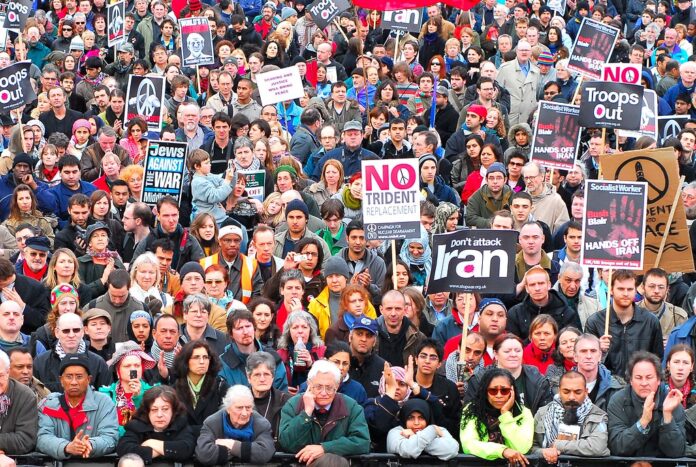
The character of a country’s regime, whether progressive or reactionary, does not justify either the imperialist attack against that country or the endorsement of such an attack. Lawless imperialist aggression that blatantly tramples on Iran’s independence and right to sovereignty—regardless of the regime’s nature—is banditry, and Iran has the legitimate right to defend itself against imperialist aggression.
Two things are important. First, opposing the imperialist attack is not the same as defending the Iranian regime, and the two cannot be equated. Opposing the imperialist-Zionist attack does not require defending the regime and its policies, or being pro-regime. It is possible to oppose both the regime and the imperialist attack, and under conditions of imperialist aggression, there is no better stance for communists than to direct the “sharp end of the spear” against imperialist aggression. Communists can only overthrow the Mullahs’ monopoly regime by building strength through the struggle against imperialism, not as national traitors or compromisers who support or remain neutral toward imperialist aggression.
The regime is not what is being defended while opposing the imperialist-Zionist aggression. American imperialism, alongside Israeli Zionism, is attacking the Iranian nations—the Persians, Azeris, Kurds, Baluchis, Arabs, etc.—with its tens of millions of workers and labourers, aiming to enslave them and plunder their wealth, particularly their energy reserves, and seizing control of the supply chain through energy transport routes. While opposing the national enslavement of peoples and the plundering of their wealth, the Iranian people defend their own national interests and values, as well as their own freedom and independence. This is precisely what the Communists support.
The second important point is to avoid being swept into the vortex of contradictions and conflicts among imperialists. It is known that Iran maintains close ties with and is in a certain alliance with Chinese and Russian imperialism, which are rivals of the US. However, the current imperialist attack on Iran, while taking place against the backdrop of imperialist contradictions and conflicts, is not—at least for now—a component of an imperialist war; rather, it is primarily directed against Iran’s independence and sovereignty. Nevertheless, it is of decisive importance not to harbour even the slightest illusion about Russian and Chinese imperialism and to maintain the utmost vigilance regarding their aims and strategies.
The overall picture of the war 25 days after the attack
As expected, the US and Israel have secured air superiority and continue to bomb Iran’s major cities, focusing on its military infrastructure.
However, the bombings are not one-sided. Iran is responding to the attacks with missiles and drones whose range and payload capacities are steadily increasing. It is targeting the American ships massed in the region, American military bases in the Gulf and Cyprus, and even in Diego Garcia, as well as Israeli cities, primarily Tel Aviv and Jerusalem, and military facilities.
Unlike during the 12-Day War in June last year, this time Iran’s missiles and drones are capable of “precision strikes” and are hitting their targets with a certain degree of success. US radar and missile defence and attack facilities in Gulf countries have sustained serious damage from Iran’s counterattacks. The US aircraft carrier Lincoln, struck by Iran, was forced to withdraw beyond range and cannot approach the Strait of Hormuz. The more modern US aircraft carrier G. Ford was pulled into maintenance in Crete following a 35-hour fire. A US F-35 fighter jet, once deemed “unbeatable” and “undetectable by radar,” was shot down. Given the US’s advanced intelligence and electronic warfare technology, the fact that Iran has acquired “precision strike” capabilities suggests that Iran, despite lacking its own satellites, may be using real-time intelligence from space provided by Russia or China to guide its missiles. While Western imperialists have provided such intelligence to the Ukrainian military in Ukraine, Russia and China have not provided anti-American intelligence to any country to date. The reason was their fear of an American backlash. Since China is much more insistent on pursuing a “soft power” approach to avoid provoking war, it is more likely that Russia, which signed a 47-article “Comprehensive Strategic Partnership Agreement” with Iran last year, could provide such intelligence. If this possibility is correct, it is clear that this would intensify the contradictions and struggles among imperialist powers.
Iranian missiles and drones are produced at a significantly lower cost compared to American and Israeli ones. From the perspective of imperialist-Zionist missile defence systems, at least five missiles are required to intercept and shoot down an Iranian missile in mid-air, and this is by no means inexpensive. Moreover, there is already talk that US stockpiles are dwindling. While Iran under bombardment is paying a heavy price, it is clear that the war is already becoming too costly for the US as well. The Pentagon is seeking an additional $200 billion military funding from Congress.
Alongside its missiles, another key weapon of Iran is the Strait of Hormuz, the primary energy export route for Gulf countries. By closing the strait, Iran has plunged the world into an energy crisis, thereby exerting significant pressure on the United States. The closure of the Strait of Hormuz immediately had an impact, causing a spike in oil and natural gas prices. Within a few days, the price of Brent crude oil surpassed $115 per barrel, reaching a peak.
And after Iran retaliated by striking Israel’s refineries, including the strategic Haifa refinery, as well as Qatar’s Las Raffan refinery, thereby rendering a significant portion of global gas shipments impossible, Trump announced that he had prevented Israel from striking Iran’s oil facilities.
The energy bottleneck resulting from the attack created inflationary pressure worldwide due to rising energy prices, while the Strait of Hormuz’s importance for the shipment of essential industrial inputs—particularly energy and petrochemicals such as plastic and fertilizers—carries the potential to trigger disruptions in supply and production chains, leading to production cuts. For this reason, Trump was forced to back down from his threat to “strike Iran’s power plants within 48 hours” and announced that they were in talks with Iran and sought to reach an agreement.
How long will the war go on for?
The American imperialist leaders, who began their attacks by claiming they would “end quickly,” have continuously extended the timeframe they initially set for the operation’s success, starting from 24 hours. Finally, after mentioning September, they have begun seeking a way to end the war in a manner that would not be considered a failure. However, ending the war through negotiations will, in any case, amount to a defeat for the aggressors.
Clearly, Iran is not Venezuela. It has a 3,000-year-old state tradition and is relatively well-armed and organized. Moreover, the imperialist-Zionist attack has led to a surge in nationalist sentiments among the factions of the Iranian people opposing the regime-, causing them to take a stance against the aggressors and thereby easing the regime’s position. When Maduro and his wife were kidnapped, Venezuela moved toward reconciliation, and the US is seizing Venezuelan oil. Iran’s “Supreme Leader” was assassinated but the resistance has not been broken, and American imperialism is now weighing its options on how to back down.
Moreover, it is clear that Iran’s resistance cannot be broken by air operations alone, and that Iran can only be “persuaded” to surrender through a powerful ground operation. Initially, proxy forces were sought for a ground operation, and the first to come to mind were the Kurds and Baluchis of Iran, and Iraq. However, the Kurds, whom the US recently abandoned in Syria, are not willing to wage a proxy war.
It is clear that American imperialism, which found even the invasion of Iraq to be costly given that its generals were bought off and its army was rotten from within, has no intention of embarking on an invasion adventure in Iran. At most, it is keeping in reserve the option of landing on the Gulf’s Hark Island, which serves as Iran’s energy distribution hub, and a few other islands, though this does not seem very feasible. Even if a few thousand US Marines were sent to the Gulf, Iran’s resistance, which includes targeting these deployed troops, along with the growing anti-war sentiment in the US itself, makes this scenario highly unlikely. Moreover, Trump, who won the election with a promise of peace but is now dragging the world into war, is in a difficult position domestically, and midterm congressional elections are this year.
Judging by Trump’s statements regarding “willingness to negotiate and reach an agreement with Iran”—which have also been endorsed by Netanyahu—a ground attack on Iran will be put on hold, at least until the next one. However, this does not appear to be straightforward, as Iran has stated it will not engage in talks without receiving guarantees and war reparations, despite having been attacked while negotiations were ongoing. A rumour circulating suggests a compromise where Iran would collect a transit fee from ships passing through the Strait of Hormuz.
What the attack on Iran revealed
• The US imperialist attack on Iran, following its attack on Venezuela—driven by an effort to halt its retreat, particularly against China, and to renew its global hegemony—along with threats against Cuba, Colombia, Canada, and Greenland, shattered the illusions about imperialism that had been constructed through its glorification. Under conditions where the term “imperialism” has been increasingly replaced by softer euphemisms like “imperial,” the world has once again witnessed imperialism and its aggression in all their glory in Iran. It has been demonstrated once more that there is no room for illusions in the era of imperialism and proletarian revolutions.
• As much as the intensification of contradictions, competition, and conflict among imperialists is a sign of that, this imperialist attack on Iran—which deepens these contradictions, competition, and conflicts with effects extending beyond the region to the entire world—demonstrates that the possibility of a world war is not so far off, thereby exposing the shortsightedness and absurdity of the view that “a world war is impossible.” The thesis put forward by the modern revisionist leader Khrushchev—which still has many proponents today—that “a world war is impossible because the accumulation of nuclear weapons and the ‘balance of terror’ prevent war,” has once again been proven unrealistic in Iran, following the situation in Ukraine, further straining relations among imperialist powers.
• Even if imperialism is not yet a “paper tiger,” it is far from the all-powerful force its exaggerated propaganda portrays it to be; rather, it is riddled with weaknesses. It became clear as early as the 25th day of the war launched by American imperialism—the most powerful force of our time, particularly in military terms—against Iran that imperialism stands on an exceedingly “fragile” foundation. Above all, it became clear that it is not “all-powerful” and cannot do whatever it wants or achieve every goal it sets. The “forward steps” American imperialism—supposedly an “invincible armada”—attempts to take end up backfiring on itself, or, as imperialism is built on irreconcilable contradictions, it “cuts the branch it’s sitting on” with nearly every move it makes. The recklessness of underestimating Iran and the energy shortages and price spikes resulting from its inability to prevent the closure of the Strait of Hormuz are proof of this. Qatar’s response to Israel’s attacks on Iran’s refineries and Trump’s call to stop Israel from striking Iran’s oil refineries are further proof. Trump’s appeal even to China to intervene in the Strait of Hormuz is a sign not only of the deadlock he has been dragged into but also of his bewilderment.
• Russia had encountered unexpected resistance in Ukraine. Although its rivals—the US and European imperialists—are not merely aiding Ukraine but have become parties to the war, the conflict in Ukraine is, in reality, a war between Russia and the US and European imperialists, with Ukraine acting as their proxy. Now, in its attack on Iran, where the conflict is not a war between imperialist powers, unlike in Ukraine, the US has encountered unexpected resistance and is falling into dilemmas. While it is prudent to avoid definitive conclusions—given that the war in Ukraine has entered its fourth year, whereas the war in Iran has not yet reached its first month—the situation is one of a classic “between a rock and a hard place.” Moreover, its rivals, China and Russia, are not on the same side of the conflict as in Ukraine and are not openly supporting Iran; it has become clear that a swift victory is unlikely, and it cannot decide whether to “call it quits” or “press on”.
The weaknesses and fragility of imperialism have been proven once again, but unfortunately, the revolutionary movement, and especially the international revolutionary workers’ movement, is not strong either, and imperialism’s weaknesses have not yet strengthened the proletarian revolution.
• The intensifying contradictions and competition among imperialists are not limited to the conflict and competition between the primary rivals—US, Russian, and Chinese imperialism. It is a fact that the contradictions and competition between the US and European imperialists, as well as Canada, have also sharpened following the US imperialists’ recent aggressive moves.
In terms of achieving the desired outcome from the attack on Iran, the task facing US imperialism—which is seeking to secure its interests through a policy of power, even at the cost of alienating its closest allies—appears difficult not only in terms of its relations with its main rivals, China and Russia, but also in terms of its relations with imperialist powers that have traditionally been its allies, particularly the Europeans.
The US, which is moving toward a separate “peace” with Russia in Ukraine without regard for the interests of European imperialists, is pressuring Canada to become a US state, while threatening European imperialists by pressuring Denmark, an EU member, to allow the US to annex Greenland, and causing the prime ministers of Canada and Italy to visit China and sign agreements with that country. Even the UK could not avoid visiting China, while Germany and France have begun to consider reviewing and renewing their relations with Russia and China. For example, the EU postponed its decision to completely stop purchasing Russian gas.
During the bombing of Yugoslavia and the invasion of Iraq, virtually all imperialist powers stood by the US. In Libya, a significant portion distanced themselves from the US. Now, in the attack on Iran, only Israel stands by the US, and the US is isolating itself through its aggression. Trump’s call for intervention to open the Strait of Hormuz, directed at all states—including imperialist powers like China and Japan and NATO members—was explicitly rejected by European imperialists, who stated that “NATO does not have such a mission,” and in response, they faced Trump’s rhetoric suggesting he might abandon NATO.
Under imperialist conditions, there is no room for permanent alliances; imperialist “peace” is nothing more than a ceasefire between two conflicts.
Labour Party – Turkey (EMEP)
24 March 2026
- * This article was written on the 25th day of the imperialist-Zionist attack on Iran, based on developments up to that point. ↑