Labour Party (EMEP) – Turkey
March 2022
The environmental movements that emerged in the 1960s with the approach of “the wind and the sun are enough for us” with the demand for renewable energy against fossil fuels and nuclear energy, diversified over time and when faced with a bundle of problems, the scope of their demands and “proposals” began to evolve.
Within the scope of neoliberal economic policies, the looting of urban assets, the increase of industrial waste and pollution, the emission of carbon and other toxic gases, the depletion of the ozone layer and the increase in the temperature of the planet, etc., all these were factors that attracted the attention of environmentalist-ecologist movements. These developments that led to a crisis that threatened human life and its natural environment not only made the issue interesting and led to the spread of protests, but also forced the monopoly bourgeoisie and state institutions to put the issue on the agenda.
Especially in advanced capitalist countries, no bourgeois government can afford to ignore the ecological crisis. Apart from economic reasons, two factors played an important role in the acceptance of the ecological crisis: first, the symptoms and devastating consequences of the climate crisis have grown with environmental disasters; and secondly, environmental awareness and the movement of the masses who react against the course of development have grown.
At present, almost all advanced capitalist countries, one after another, have announced many “ecologically” defined financial packages, legal measures and political decisions in the name of “protecting nature” and “solving the climate crisis”. At the summits in Tokyo, Paris and most recently Glasgow, “historic resolutions” have been agreed upon. For example, under the Paris Climate Agreement, global carbon emissions must be reduced by 55% by 2030 and down to zero by 2050 in order to limit the rise in the world’s temperature to 1.5°.
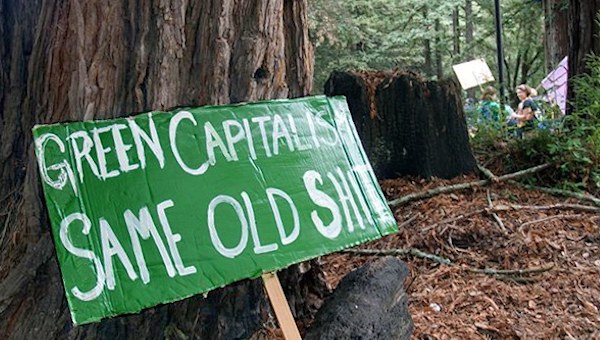
The “solution” developed by the monopoly bourgeoisie and capitalist states against the destruction of the environment came out to be “green capitalism” with production factors of reduced carbon emissions. With an intense propaganda, rosy pictures were painted of “green capitalism” (i.e. “global energy transformation”, “green cities”, “recycle economy”, “green industrial revolution”, etc.). Even if the objective conditions of capitalism have been dragging the world into destruction and are not suitable for this role, current subjective conditions characterized by the low level of organization and consciousness of the working class, as well as the main ideological environment, allow this “solution” put forward by the monopolies to find a substantial audience, at least for the time being.
*
Although it was generally accepted that the natural and climatic conditions were gradually deteriorating, the views put forward in the name of a solution were mainly in a liberal bourgeois reformist and petty-bourgeois anarchist framework. The so-called “environmental movement” included the middle and petty bourgeois sections, as well as a section of rural and urban workers; its main demand in its initial years was the regulation of production in a way that would prevent the destruction of nature and living spaces. In the course of its development, this movement produced splits that formed a barrier against the labour movement with the defence of “green capitalism”, as well as those who took a stand against the monopoly capitalist plunder of nature. The “green” movement generally kept the critique of capitalism at a level acceptable to the bourgeoisie and blamed “humans”, not capitalists and monopoly capital, for the destruction of nature, suggesting that “individuals bear responsibility” and that the state(s) should follow a “bioeconomic policy”.
The increasingly severe consequences of environmental and climate problems led to the suggestion of putting boundaries on capitalism as a solution. This liberal bourgeois approach envisaged certain technical and economic arrangements, such as not exceeding the natural regenerative capacity of resources, avoiding excessive solid and liquid waste, avoiding pollution, maintaining adequate quality of air, water and soil, and protecting biodiversity. This approach blames “humans” for the deterioration of nature and climate, and covers up the capitalist commodification of nature, putting the “disruptive effect” created by the workers and labourers as human beings by use of heating, lighting, shelter and transportation vehicles, at the same level as the damage done to nature by petrochemical and automotive monopolies.
Liberal bourgeois environmentalism hides the class differences in society and its consequences; it obscures the fact that individuals are in different positions as they belong to different classes in accordance with their relation to the means of production. Though it cannot whitewash capitalism completely, this liberal approach equalizes a monopoly bourgeois with a worker in their relations with nature; it claims that our world has come to a stage where it cannot afford the actions of its population, which will reach ten billion soon, on the environment, and the responsibility for this belongs to all people who consume it nonstop and use technological advances for this purpose! What this “free market environmentalism” based on “sustainable development” proposes as an alternative is the planned reduction of rapid population growth and the persuasion of international monopolies and bourgeois states to “alternative projects”.
There are also those approaches which claim that the “ecological crisis” is caused by the rapid change in the relations between humans, society and nature as a result of the capitalist production and industrialization by means of technological advances, that they give “a Marxist response to the ecological crisis”. Stating that ecological deterioration has reached a “global and irreparable level” posing a “threat to all living things” and drawing attention to the capitalist basis of the problem, the approaches and solutions of ecological socialism (and anarchism) differ when it comes to nuances. Nevertheless, they have common approaches in their conditioning that human emancipation is only possible “with the end of their domination over nature”, in their opposition to industry, especially the automotive and chemical industries, and in their defence of limited production and consumption based on the view that “environmental resources are limited”. What they have actually in common is their blindness to capitalism and surplus-value, reaching an extreme point in the views of Murray Bookchin, the defender of eco-anarchism, with the propositions that make capitalism de-capitalist, who argues that the basic contradiction humanity faces is between capitalist continuous growth and the limited resources of “nature that exists by maintaining a balance”.
*
It became possible to make propaganda for “green capitalism”, which is an overt defence of capitalism, in an ideological atmosphere where the working class and its movement do not have a sufficient level of organization and consciousness, and where bourgeois-liberal and reformist approaches claiming opposition to the existing order had a certain acceptance with their views on environment and nature, especially with regard to relations between nature and human beings that have been detached from their social class content.
For example, a sleight of hand was probably necessary for the capitalists to popularise “green capitalism” in society, under the conditions where oil and gas production, with their legendary monopolies, was known to be the driving force of international capitalism for many decades, and a certain connection, even if blurred, was still established between capitalism and the destruction of nature. Liberal-reformist environmentalist approaches prepared the grounds for this, spreading views on the relationship between nature and human beings that was disconnected from their social and class content. What was left to the monopoly bourgeoisie and its ideologues was the naturalization of social relations: they attempted to reflect the current social relation not as that of a particular society at a particular stage in history, but as the most natural and usual relation of humanity. They started out by considering the capitalist mode of production inviolable, not as a specific historical mode of production, but as the natural mode of production of humanity. There was no other way; only with purely natural capitalism progress could and would be possible!
With this approach, the ecological crisis has been brought into a form that is compatible with its universal character as a phenomenon. Ecological disaster was a universal problem of all humanity and therefore all people, all societies and countries should take responsibility! Thus, the undeniable causal relationship between the capitalist mode of production and ecological catastrophe has been transformed into an ordinary manifestation of the relationship of “human nature” with nature by naturalizing capitalist relations. In this way, the problem of ecological disaster, a problem that interests all humanity and living things as a whole, appeared before us as an inevitable consequence and problem of “human nature”, i.e. of production and consumption! The conclusion that can come out of this is simply that “We humans are responsible for the ecological crisis with our production and consumption”! Thus, the problem was isolated from the systemic dimension of the mode of production and reduced to a style of life and consumption or a technology problem. Capitalism has been shrewdly whitewashed and a point that is acceptable to monopolies has been reached: it is not capitalism that is responsible for the ecological crisis, but this or that sector, company party, or politician!
So, in order to act on a solid ground in the struggle to overcome the ecological crisis, the fundamental link that needs to be highlighted is the fact that the capitalist mode of production is neither the most natural nor the only mode of production without alternatives. It is capitalism that must be eliminated in order to survive ecological destruction.
*
There are many characteristics that distinguish the capitalist mode of production from previous social formations, but the aspect we need to emphasize in terms of our subject is that in the production of surplus-value it realizes the production of relative surplus-value in a large-scale, scientific and systematic way in addition to absolute surplus-value. The production of relative surplus-value is primarily based on the increase of labour productivity over a given period of time. There are many dimensions and necessities of this increase in labour productivity, but its result is clear: capitalism gets the opportunity to organize a much more widespread, rapid and large-scale production than the previous modes of production. By putting science and technology at the disposal of capital, increasing productivity and therefore production capacity on an enormous scale means that all the underground and aboveground natural resources are plundered at a scale not seen in any pre-capitalist social formation, turning them into a means of obtaining surplus-value.
Thus, the reckless destruction of nature and ecological balance becomes a natural necessity for capitalism. Moreover, because of competition between capital and especially monopolies, the faster and greater the plunder of nature, the more successful the people responsible for this destruction are considered. In short, the reckless plundering and destruction of nature is inherent in the capitalist mode of production, whose sole purpose is the production of surplus-value, which is an indispensable aspect of it.
Ecological crisis means that the level of sharpening of the contradiction between the limitless drive for capital accumulation and the natural conditions of living things has reached a point where it cannot operate as before in the form that has hitherto been able to hold together the mutually excluding aspects of the two. And when this trend cannot be stopped, it means that a threshold will be crossed where irreversible destruction will occur in the natural conditions of living things.
Capital’s approach to nature takes place on the basis of a measure that does not exist in nature itself, that is the production of value and surplus-value. As the increased productivity of labour and the brigand plunder of nature go hand in hand, nature, like everything else, is subordinated to the law of value and capitalist commodity production.
However, while this is the character of the relationship between capitalism and nature, the market and its laws are the basic criteria of all the measures taken under the name of the fight against the ecological crisis at the ecology summits where capitalist states and their representatives come together. This is the pinnacle of hypocrisy.
It is not only that mines, waters, minerals, soils etc. have been commodified, but nature itself has also been transformed into a huge sea of commodities with the new possibilities offered by science and technology. Today, bio and gene technology is applied to agricultural commodity production; genetic information contained in some seeds and certain endemic plants is patented; and the sun and wind is converted into energy and sold. Interestingly, we are witnessing the fact that, under the name of combating the climate crisis, carbon dioxide emission, which is considered to be the main cause of the climate crisis, is itself turned into a commodity that can be bought and sold!
As a matter of fact, the Emissions Trading System is a striking example of this, and it reveals how and with what kind of logic the climate crisis is being fought under capitalism.
As is known, in line with the “climate change prevention target”, the Kyoto Protocol introduced a regulation regarding the amount of worldwide carbon dioxide emissions: emissions trading. This takes place according to the “cap-and-trade-principle”. A cap was set on the amount of worldwide carbon dioxide emissions, and this amount was shared between states in the form of a carbon emission right (certificate). Every country that has signed the Kyoto Protocol (191 at present) obtains the right to emit carbon in the amount determined in the protocol. It goes without saying that the right to carbon emissions is the right to pollute the atmosphere. When some countries reduce their carbon emissions, they accumulate their unused polluting rights in the form of emission certificates, which are then put up for sale on the international market and bought by states that have released more carbon than they are allowed. And just like governments, companies can buy and sell their carbon emission rights (emission certificates).
The truth is that the amount of carbon released into the atmosphere is left to the laws of the market. The market, on the other hand, operates according to the law of value, not the laws of nature!
Two news articles from Bloomberg reveal another fact: The first one, titled “Raw material price pressure on the green transition”, states the following:
“Large price increases are on the horizon for key raw materials such as cobalt, copper, lithium and nickel. According to a study published by the German Economic Research Institute, the demand for these raw materials will increase rapidly in the coming years.
“Of course, this could become one of the hurdles that will complicate the transition to green energy, because these raw materials are currently indispensable for the production of electric cars, solar panels and wind turbines. Large amounts of copper are needed to build wind and solar power plants; and cobalt, lithium and nickel are needed for electric car batteries. According to the International Energy Agency (IEA), copper consumption is expected to double, nickel consumption is expected to triple, and cobalt consumption is expected to increase six-fold in the next 20 years.
“The largest increase in demand is expected for lithium. It is predicted that the demand for lithium in 2040 will be exactly 20 times higher than today. It seems difficult for supply to keep up with this level of demand, because large investments are needed for the extraction of these metals. According to the scenario announced by the German Economic Research Institute, copper prices may be 70 percent higher and lithium prices 180 percent higher in 2030 compared to 2020.”[1]
The second piece is about the calculation of Bloomberg New Energy Finance. By that reckoning, the “global energy transition” characterized by the shift from oil and gas to wind and solar energy “will require investments worth $173 trillion in energy supply and infrastructure over the next 30 years.”
It is undeniable that the data in the two reports show the reasons behind the “green passion” of finance capital: profit and new investments for it.
While the trend towards “green capitalism” is causing the monopolies that have invested in oil and natural gas, which has long been at the top of the “largest companies” lists, to lose power together with their discredited sectors, it is clear that the increase in raw material prices will be in favour of the capitalists who invested in these raw materials and against the capitalists who use them in production. And it seems inevitable that this situation will intensify the competition between capitalists and spark new investments by including sectoral innovations as well as innovations in the technology used. Considering that oil and gas resources will be depleted in a few decades, “global energy transformation” as a fundamental aspect of “green capitalism” was actually necessary, and it seems inevitable that the monopolies that have invested heavily in this sector cannot avoid their “destiny” unless they diversify their investments and take precautions. However, the price increase in certain raw materials shows that sectoral fluctuations are also normal and that the uneven development of capitalism is evident in all areas, and all this will intensify competition, especially among monopolies.
*
“Green capitalism” is the propaganda that the ecological crisis can be overcome within the current capitalist mode of production. Accordingly, the fight against the ecological crisis must be done in accordance with the laws of the capitalist economy and the market. Then, if capitalism will not cease to be capitalism with “green capitalism”, which no one claims, the following question needs to be answered: Are the laws of the capitalist economy and the market compatible with the steps required to overcome the ecological crisis? Leaving aside all other questions, examples of carbon emissions trading, possible increases in raw material prices and the enormous investments required by the energy transition all indicate that they are not compatible. Just as it is not surprising that the capitalist pursues profit, there is no reason to be surprised at this! A capitalist is a capitalist because his sole aim is profit, and the capitalist economy and the market have their own laws which differ from the laws of nature.
The main reason why capital is turning to the “green transformation” today and not 20 years ago, for example, certainly has nothing to do with the increase in global warming, but with the changing rates of profit.
The proof is simple, given the transformation highlighted in the energy sector: The technology used today in renewable energy is not new and has been around for decades. However, until recently, factors such as the cost of production using this technology, labour productivity, market volume, preventing or delaying the devaluation of the capital invested in fossil fuel, has kept the monopolies away from investing in this field, because it was not profitable enough. However, the ecological crisis has not been a problem of just a few years and it made the use of these technologies necessary many years ago. However, because it was not profitable, these technologies, which are now being promoted at a high pitch, were not invested in then. Today the situation has changed. In addition to the limited oil and gas reserves, for example, the “hydrogen market” alone has now reached $150 billion. By 2050, it is expected to reach at least $600 billion. Investing in this field is now worth competing for it! And now capitalist states with their “ecological funds” have begun to meet the cost and competitiveness challenges for their classes of capitalists.
Marxists have never found it strange that capital pursues profit. On the contrary, Marxists have exposed capital and capitalism, which are not and cannot be based on human beings, their health or nature in general, since profit is their sole reason and purpose of existence. What is interesting is that those who describe Marxists who advocate overcoming the capitalist order as “dreamers” expect capital not to behave like capital using “green capitalism”!
A question may come to mind: Is it not better to turn to “renewable energy”, “green transformation”, “clean industry” now, even if it is for the purpose of capital accumulation? Is it not true that every lessening of the destruction of nature counts as a gain?
No doubt. However, the point where the destruction of the ecological balance has been reached has already made the best-of-evil approaches meaningless. The current magnitude of the ecological crisis and the dynamic in its development trend imply that possible “gains” will not actually be gains, and every lost day, that is, leaving the historical task of overcoming this crisis to the selfish and frivolous interests and impulses of capital, means that we are getting closer to the turning point where the “irreparable rift” (Marx)[2] that capitalism is causing in nature can no longer be reversed.
*
On the other hand, the emergence of “green capitalism” on the agenda as a result of the “ecological crisis” also implies that the capitalist mode of production itself is open to discussion on the basis of a criterion that capital is unable to control directly. This is the criterion of the question of existence or non-existence of nature which creates the conditions for humanity and all living things. This debate takes two forms today. 1) The common and dominant approach is as follows: If nature is in question, this is a universal and supra-class problem which concerns all humanity equally and everybody should take responsibility. 2) This is a problem that is universal and therefore has a dimension that interests the entire planet and humanity but is specific to a certain mode of production (capitalism) in which a certain class (capital) is dominant in terms of responsibility.
Obviously, it is the subjective dimension of the problem that makes the first approach dominate. The main reason for the dominance of the bourgeois approach is that the “ecological crisis” has emerged at a stage where the multi-faceted devastation of the historical defeat of the working class has not yet been overcome and where the working class cannot leave its mark on political struggles with its independent movement. As a matter of fact, it is today’s reality that those who believe that the end of the world may come due to carbon emissions, climate change and rapid temperature rise, do not believe that there is an alternative to capitalism, and unfortunately this approach keeps the majority under its influence.
However, the historical reality is that we are faced with an objectively overripe capitalism in that it is overdue to be replaced by a social order that is its opposite. This is capitalism that is objectively outdated, not only in terms of the severe economic, social and cultural contradictions in the social life of the peoples of the world, but also in terms of putting the natural living conditions of the human species at risk on this planet.
The ecological crisis we are in manifests itself in the erosion of the form in which the contradiction between the conditions of existence of capitalism and the natural conditions of living things has undertaken up until now. Where we are now requires the termination of capitalism’s exploitative and plundering relationship with nature, at least in terms of nature’s reaction. However, the current situation of the subjective factor determined by the consciousness and organizational level of the working class, which is the main force that will end the domination of capital, is not ready to take this urgent step, at least in terms of guaranteeing the survival of the life at risk.
The so-called “green capitalism” is an attempt to reshape the contradiction that has reached its peak in capitalism’s relationship with nature in favour of capital but against ecology, and thus to continue the destruction of nature by plundering it. This initiative will have an ecological, economic and social bill which the workers and labourers of the world, especially the youth and the oppressed peoples, will be expected to pay.
———————
- https://www.bloomberght.com/yesil-gecise-hammadde-fiyati-baskisi-2297569 ↑
- Reading Jesus von Liebig’s book “Agricultural Chemistry”, Marx was interested in the causes of soil depletion and approached the problems of the social material exchange with nature from an ecological perspective, considering them as a contradiction of the capitalist mode of production. The plundering of nature was a problem of modern capitalist social production, and according to Marx, the plunder of nature would continue: “in this way it produces conditions that provoke an irreparable rift in the interdependent process of social metabolism, a metabolism prescribed by the natural laws of life itself. The result of this is a squandering of the vitality of the soil, and trade carries this devastation far beyond the bounds of a single country.” (Karl Marx’s Economic Manuscript of 1864-1865, translated by Ben Fowkes, p. 798) ↑