J. Romero
“… The new imperialism differs from the older, first, in substituting for the ambition of a single growing empire the theory and the practice of competing empires, each motivated by similar lusts of political aggrandizement and commercial gain; secondly, in the dominance of financial or investing over mercantile interests.
…”. Lenin, “Imperialism: The Highest Stage of Capitalism.” FLP Peking, page 109.
This quote from the book “Imperialism” by the English author Hobson, is taken up by Lenin in “Imperialism: The Highest Stage of Capitalism”. Lenin, who in this work masterfully characterizes from a Marxist point of view the new stage of dying capitalism, attacks the social-chauvinist degeneration of the revisionists of his time, who embellished the predatory and violent character of capitalism, creating false illusions about peaceful competition between the powers in an “ultra-imperialism” that would anticipate its self-improvement. Regarding these idealist fantasies, he writes: “…We see that Kautsky, while claiming that he continues to advocate Marxism, as a matter of fact takes a step backward compared with the social-liberal Hobson, who more correctly takes into account two “historically concrete”…features of modern imperialism: 1) the competition between several imperialisms, and 2) the predominance of the financier over the merchant….”.
He adds: “… The essence of the matter is that Kautsky detaches the politics of imperialism from its economics, speaks of annexations as being a policy “preferred” by finance capital, an opposes to it another bourgeois policy which, he alleges, is possible on this very same basis of finance capital. It follows, then, (for Kautsky) that. It follows, then, that the territorial division of the world, which was completed precisely during the epoch of finance capital, and which constitutes the basis of the present peculiar forms of rivalry between the biggest capitalist states, is compatible with a non-imperialist policy. The result is a slurring-over and a blunting of the most profound contradictions of the latest stage of capitalism, instead of an exposure of their depth; the result is bourgeois reformism instead of Marxism…” Ibid., p. 110-111. (I highlight in bold the parts of Lenin’s text which allow us to better compare the opportunist tendency of that time with that of today.)
Our Party always fought against the social-imperialist character of the revisionist foreign policy of the USSR; at that time, we were confronted with the old revisionist parties that virulently defended the thesis of the national roads to socialism and justified the chauvinist alliance of the revisionist leaders with all kinds of populist currents that contributed to weakening the socialist camp.
Since the implosion of the USSR, betrayed from within by the clique which includes the Yeltsin’s, Putin’s and a large part of the current oligarchic mafia that controls power in Russia and in the states that emerged after its destruction, the revisionists, far from abandoning their support for the theses of chauvinist opportunism, have redoubled their efforts to portray the policy of some of the most aggressive imperialist powers as advanced and progressive. They have gone a step further: they once rejected the policy of China, a country that was then formally “socialist” and a “rival” of the USSR, which was already preparing for the leap to State Monopoly Capitalism (it is true that the sole intention of the opposition of the partisans of Khrushchevism was to defend the leadership of the CPSU from the formal criticisms of the Chinese leaders who accused them of being revisionists). Today, however, they have extended their explicit support to the Chinese imperialist power in its struggle against “Western imperialism.”
There are no limits to this eagerness of the revisionists to justify their social chauvinist policy, pandering to one imperialism against another. In their eagerness to be lackeys of the bourgeoisie they justify everything: from the wars of annexation of the “good” imperialists, to their financial penetration into the dependent countries to place them under their political rule, the activity of their private “armies” in the “backyards” where the inter-imperialist war is actually being waged, etc.
When it is (often) necessary and to embellish friendly imperialism, they conceal the most obvious contradictions: that there are private armies at the service of their economic and political interests, that they attempt coups d’état against the governments whose interests they protect; that ultra-reactionary states that are the engine of wars and conflicts that create hundreds of thousands of innocent victims and have been (and continue to be) firm allies of brutal Yankee imperialism for decades, such as Saudi Arabia, are taking steps towards the other imperialist camp in order to follow their own path of expansion for their financial capital; even, as we shall see later, to defend without blinking or blushing the policy of the “Western” imperialist bloc, at the same time they praise the attempts of its “Eastern” rivals to create what they cynically call a more “just” “multipolar” world. As Lenin pointed out in the above quotation, for them, as for Kautsky: “monopolies in economics are compatible with non-monopolistic, non-violent, non-annexationist methods in politics.”
Lenin wrote his book on imperialism more than a century ago (1916), when the first socialist revolution in history, led by him, had not yet taken place, and Europe was bleeding in a cruel war in which the interests of the main powers of that time were settled; a carnage whose conclusion was only a truce that would give way to the most brutal confrontation in the history of humanity: World War II. Since then, bourgeois historians have only recognized a long period of peace between the great imperialist powers, subject to the order imposed by the power that emerged strongest from the Second World War, the United States, whose policy was imposed on the rest to regulate relations between them and divide the world; a brutal imperialism that has maintained “order” with an iron fist. It is an imperialist power in decline that still has the largest military budget on the planet, far ahead of its competitors, ready to maintain its power over the rest at all costs.
But that peace was always relative; over the years, there have been dozens of conflicts that have made countries disappear, changed maps, destroyed economies and provoked wars that ended the lives of millions of people: coups d’état, invasions and military occupations, criminal attacks against independent States under the pretext of fighting terrorism, etc. Only the bourgeoisie and its admirers speak of peace when it comes to imperialist policy.
About the BRICS.
“… Typical of the old capitalism… was the export of goods. Typical of the latest stage of capitalism, when monopolies rule, is the export of capital… Uneven and spasmodic development of individual enterprises, of individual branches of industry and individual countries, is inevitable under the capitalist system…. As long as capitalism remains what it is, surplus capital will be utilized not for the purpose of raising the standard of living of the masses in a given country, for this would mean a decline in profits for the capitalists, but for the purpose of increasing profits by exporting capital abroad to the backward countries. In these backward countries profits are usually high, for capital is scarce, the price of land is relatively low, wages are low, raw materials are cheap.
. Lenin, Ibid., pp. 72-73.
Revisionism does not distinguish (and never has) the tendencies in the changes that take place in the different social and economic formations that have emerged as capitalism has developed, because they have renounced Marxist analysis and its revolutionary aim. Revisionism is a bourgeois ideology based on the idea that the capitalist mode of production can be improved but cannot be overcome. That is why its conclusions are absolutely unclear.
We communists know that in a socialist system (such as that of the USSR under Lenin and Stalin) the economy is not only centralized, but socially controlled. But it is not isolated from the rest of the world. As long as the revolution has not been achieved in the whole planet, or at least the most developed states, the proletarian state will necessarily have to maintain commercial and financial relations with other, capitalist countries, including, of course, the great imperialist powers, which are economically and politically hostile. But this does not mean that relations with those undeveloped countries are established on the basis of gaining economic or political control of them, nor that it acts in a way that ignores the predatory nature of capitalism.
******
Nor does it mean that, under the current conditions, supported by this interconnection between the different economies, any policy opposed to the policy of the Yankee state is justifiable for that reason alone. At present, capitalist economies are profoundly interrelated, whoever dominates the mechanisms and agencies that regulate these relations and facilitate investments will be able to favour the expansion of its capital and control the economy of other nations and economic regions, as the United States has done so far. For this reason, what was once a silent advance of Chinese state capitalism has become a fierce fight with the US for control of the areas of influence and the agencies and mechanisms that regulate inter-imperialist relations. Today, the struggle between the imperialist states that dominate the world has taken a qualitative leap: the financial movements have a global scope and are marked by China’s attempts to contend for the areas hitherto controlled by other imperialist powers and to limit the control of the US and its currency, the dollar, in the international movement of capital on the one hand; and by the U.S. policy aimed at maintaining the current status quo at all costs on the other.
From the beginning, the BRICS (an acronym for the countries that make it up: Brazil, Russia, India, China and, since 2010, South Africa) was of interest to China to help create a “counter-power” to Yankee imperialism. Despite its deep internal contradictions, which I will talk about later, this forum serves China and Russia to try little by little to form a new bloc in the inter-imperialist struggle for the redivision of the world, as opposed to the one formed by the “West” led by the United States.
The leaders of the two imperialist powers that lead the BRICS do not hide their intentions either; in March of 2023 there was an interview between XI Jinping and Putin in which the Chinese leader stated as he said goodbye: “Changes are taking place that we haven’t seen in a hundred years, and we’re leading them together”.
Perhaps because of their past or the “socialist” disguise of these states, the revisionists have become their propagandists and repeat to anyone who will listen the nonsense about the altruism of their policy, the peaceful character of their investments and the promising possibility of a new “multipolar” order that would put an end to the internal contradictions of the imperialist economy and in whose gestation the BRICS occupies a prominent place to the extent that, according to them, it is serving to attract new states towards a “humanist” alternative to the different organizations (OECD, IMF, G20, etc.) that regulated inter-imperialist relations during the era of Yankee domination. Let us see, then, what is the class character and the policy pursued by the two allied powers, China and Russia.
When analysing the economic and political relations between states, we Marxist-Leninists are always guided by a class criterion: a socialist economy, as I pointed out above, is not only centralized, but also socially controlled by the people and, therefore, private initiative is restricted to small-scale local production and distribution. That is why, when dealing with the economic and political relations between countries at a time as confusing as the present, to compare the policy of the USSR during Stalin’s lifetime with that of the revisionism that followed, and even less with that of the gangster power that today controls the Russian state and the countries that emerged from the implosion of the former, is a betrayal of Marxism that helps to maintain this confusion.
After Stalin’s death, the economy of the USSR remained formally “socialist” to the extent that there was a centralized economy and most enterprises were formally owned by the state, although the underground economy and the theft of the social product by the caste that controlled the activity of the state enterprises and state institutions gradually grew as social control weakened, until the disappearance of the USSR and the division of the collective property among the gangsters who today control those states. Today, the Russian proletariat is subjected to one of the most ferocious systems of capitalist exploitation; of the heroic experience of the Soviet Union, there is only the memory that the ruling clique headed by Putin skilfully uses when it is in his interest to justify his aggressive policy.
China.-
“From the very first steps of its activity, the Communist Party of China displayed open nationalist and chauvinist tendencies, which, as the facts show, could not be eradicated during the succeeding periods, either. Li Ta-chao, one of the founders of the Communist Party of China, said, ‘the Europeans think that the world belongs exclusively to the whites and that they are the superior class, while the coloured peoples are inferior. The Chinese people,’ Li Ta-chao continues, ‘must be ready to wage a class struggle against the other races of the world, in which they will once again display their special national qualities.’ The Communist Party of China was imbued with such views right from the beginning.” E. Hoxha, “Imperialism and the Revolution,” p. 435-436.
In the case of China, there has never been a socialist economy. Its Communist Party, practically from the beginning, “adapted” Marxism to a particular ideology that the Chinese leaders called “Mao-Tse Tung Thought.” The confused idealistic gibberish of this thought initially went unnoticed when modern revisionism took control of the CPSU, as the Chinese party presented itself as the standard-bearer of the Marxist-Leninist nuclei that emerged in the old parties and rejected the rotten ideology of Khrushchev and Co. It didn’t take long for the true character of the “Chinese road to socialism” to be revealed.
In his book, “Imperialism and the Revolution” Enver Hoxha takes up this quotation that shows the idealist and petty-bourgeois character of so-called “Mao Tse Tung Thought”: “”Actually all ultra-reactionaries of the world are ultra-reactionaries, and they will remain such tomorrow and the day after tomorrow, they will not remain such unto death, and in the end they change… Essentially, ultra-reactionaries are die-hards but not stable… It may happen that ultra-reactionaries may change for the better… they come to see their mistakes and change for the better. In short, ultra-reactionaries do change”. (Quoted from “Imperialism and the Revolution,”) p. 430.
Comrade Enver Hoxa added: “Proceeding from such anti-Marxist concepts, according to which with the lapse of time the class enemies will be corrected, he advocated class conciliation with them and allowed them to continue to enrich themselves, to exploit, to speak, and to act freely against the revolution. To justify this capitulationist stand towards the class enemy, Mao Tsetung wrote: ‘We have a lot to do now. It is impossible to keep on hitting out at them day in day out for the next fifty years. There are people who refuse to correct their mistakes, they can take them into their coffins when they go to see the King of Hell”” (Quoted from “Imperialism and the Revolution,”) p. 431.
The theses of the CCP have always been benevolent towards the role of the bourgeoisie, they have rejected the role of the proletariat for social change, centred the leading role of the revolution on the peasantry, and have always maintained an indulgent and opportunist attitude towards the exploiting classes. This attitude guided the CCP’s policy from its beginning.
Throughout their history, the Chinese revisionists have been shaping an apparently erratic policy step by step but always guided by the objective of occupying the zenith of the imperialist camp: the so-called “theory of the three worlds” gave a green light to the so-called “ping-pong diplomacy” that for years made the Chinese government an objective ally of Yankee imperialism. Hence: “To get rich is glorious,” Deng Xiaoping ‘s war cry. China has been applying its model of state capitalism, although always using its “Socialism with Chinese characteristics” as an alibi for the naïve.
It is worth rereading Enver Hoxha, when he stated: “As very lengthy experience has already proved, state capitalism is supported and developed by the bourgeoisie, not to create the foundations of socialist society,.. but to strengthen the foundations of capitalist society,… in order to exploit and oppress the working people more. Those who run the ‘public sector’ are not the representatives of the workers, but the men of big capital, those who have the reins of the whole economy and the state in their hands. The social position of the worker in the enterprises of the ‘public sector’ is no different from that of the worker in the private sector.” E. Hoxha, “Eurocommunism is Anti-Communism”, Tirana, 1980, pp. 145-146.
******
China has increased its GDP fivefold since 2001 and is the world’s largest creditor. Today, for some, the champion of a more just and multipolar world is already the power that is contesting the hegemony of the imperialist camp with the United States. But it is not the working class that controls this development.
As Comrade Enver Hoxha pointed out: “Unified central planning becomes possible only where complete social ownership has been established over the means of production, and this is characteristic only of socialism. Private property, in whatever form, has not submitted and never will submit to centralized planning.” E. Hoxha, Ibid., p. 223.
The official Xinhua news agency reported in June 2022 that the number of private companies had quadrupled in the last ten years (from 10.85 million to 44.57 million). The private sector accounted for more than 50 per cent of tax revenues, more than 60 per cent of GDP, more than 70 per cent of technological innovations and 80 per cent of urban employment. Where do its apologists see socialism in the Chinese economy?
A few months later, Sputnik World included the list of the top ten Chinese billionaires, headed by Zhong Shanshan with $65,000 million and ended with Colin Huang Zheng with $24,300 million… Where do the sycophants of “Socialism with Chinese characteristics” see socialism?
It is now even easier to understand what Comrade E. Hoxha meant when he said: “As a result of these anti-Marxist concepts about contradictions, about classes, and their role in revolution that ..Mao Tsetung thought* advocates, China never proceeded on the correct road of socialist construction. It is not just the economic, political, ideological and social remnants of the past that have survived and continue to exist in Chinese society, but the exploiting classes continue to exist there as classes, and still rernain in power. Not only does the bourgeoisie still exist, but it also continues to gain income from the property it has had” (E. Hoxha, “Imperialism and the Revolution,” p. 433.)
******
In other words, the fight to form another bloc responds to China’s interest in breaking the current status quo in the imperialist camp. Its economy represents 18% of the world’s GDP and it is the world’s largest creditor; even in 2019 it possessed $1.2 trillion of Yankee debt. Meanwhile its main rival, the United States, which until today controls the main agencies that regulate the economic, political and military relations of capitalism, is, however, a great power in decline that is facing a severe crisis and a public debt that reaches $30 trillion, an amount equivalent to almost 133% of its GDP (the highest figure in its history). Yet China only has a 5% voting share in the World Bank’s main lending arm (the top management positions of the World Bank and the IMF have been divided between the US and Europe since their creation).
The Chinese state, therefore, is not fighting to secure a “Fairer and more equitable global governance,” as its president said in his speech at the meeting (see below), but to “balance” its economic weight in the imperialist camp with its political weight in the agencies that regulate relations within it; to resolve a contradiction that prevents it from being recognized as “first among equals” in the Olympus of capitalism. To do this, it is moving its pawns to influence areas that until now “belonged” to its Western rivals and it is investing huge amounts of money in undeveloped countries, because, as Lenin pointed out, there profit is high, capital is scarce, raw materials as well as the land is cheaper on which, in some cases, there is an abundance of rare materials essential for the most modern production processes.
******
Russia.
The proletariat of that immense country led the first socialist revolution and created the USSR, the first proletarian state in history; For almost forty years it built a socialist economy, guaranteed immense social, political and cultural progress to its people, helped the revolutionaries of the world to organize and advance against their respective bourgeoisies and defeated the fascist Nazi beast. During those years, all the attacks of imperialism crashed against the insurmountable wall of a people on the march led by a Communist Party armed with a scientific ideology and made up of the best cadres that emerged from the people.
Today, that state has disappeared and, in its place, revisionism ended up giving birth to a reactionary state formed and dominated by the bourgeoisie who appropriated the wealth created by the Soviet people. It is an implacable bourgeoisie that hides behind the glorious past of the USSR to ensure it a certain social stability when the people’s weariness with their gangster exploitation has become unbearable. Today the Russian bourgeoisie is trying to make us forget that experience and is showing the scarecrow of tsarist “Great Russia” while trying to appropriate the victory of the glorious Red Army against Nazi fascism; all in order to embellish its brutal exploitation and the disgusting nationalism of its international policy.
A June 2001 article published by the IMF stated that, according to official estimates, as early as 2000, the Russian private sector generated more than 70 per cent of GDP, compared with less than 10 per cent just eight years earlier, when the “reform” began. It added: “This is a remarkable achievement, but the expansion of the private sector is mainly due to the privatization of state-owned enterprises, and not to the creation of new enterprises.”
Things have not gone badly for Russian big capital: in 2019, Forbes magazine reported that the 200 largest private companies in Russia saw their total revenues increase by 22% in 2018, reaching around €618.11 billion. In fact, only 19 of the companies included in the survey had declining indicators compared to the previous year.
The invasion of Ukraine, as much as they want to justify it by the pressure exerted by the US and NATO and by the reactionary character of the Ukrainian regime (both of which are true, of course) has meant a further escalation in the race of thugs among the imperialists. It is clear that, instead of preventing NATO’s eastward expansion, Russian aggression has only served to begin an armed conflict that is claiming thousands of victims, extend military tension among the imperialist powers and reinforce nationalist tendencies in the area. In short, it is not the interests of the Russian people or the Ukrainian people that are at stake in this fight, but those of their respective oligarchies and the most reactionary sectors of both countries, whose policy is not far from Nazism.
Behind the analyses of bourgeois political scientists, historians and military strategists, the sermons of politicians and religious leaders on peace and democracy; the false reasons based on historical brotherhoods, shared empires, and national or racial identities, there is only one real explanation: the financial oligarchy is facing a crushing crisis that it can only be overcome by contesting with its rival over its prey. Putin’s Russia has nothing to do with the Soviet Union; the army that today is shelling and bombarding Ukraine is not the Red Army, in which Russians and Ukrainians fought together against Nazi fascism until it was defeated. Putin, like his Ukrainian enemies, is the head of a reactionary regime, controlled by political gangsters.
Russia is also acting as a gendarme in other parts of the world, especially in Africa, where, as a complement to the “invasion” of Chinese capital, it offers military power: weapons, advice and training, etc., including its own mercenary army, the Wagner group, in exchange for raw materials and political influence in the face of future conflicts. Taking advantage of the righteous anger of the peoples of the area against the cruel exploitation of “Western” imperialism, the Russian empire is occupying the positions left empty by the “West.”. This happened in Libya and today the Russian penetration through the private group of mercenaries in the Sahel is extending to the Central African Republic, Chad, Burkina Faso, Mali, etc. The greed of French imperialism, which is interested only in obtaining maximum profits, ignoring the sufferings of the peoples it occupies with the argument of the “fight against jihadist terrorism,” has provoked constant revolts and coups d’état and facilitated the entry of Russian troops into the area, also in “defence of peace against jihadist terrorism”, the often-repeated excuse to bleed Africa dry in endless wars. Russia is gradually increasing its presence and influence in Africa. Like the Western empire, it is extending its control, presenting itself as one more actor in African politics: recently, for example, it was reported that a Russian naval base was being built in Sudan, with access to the Red Sea.
******
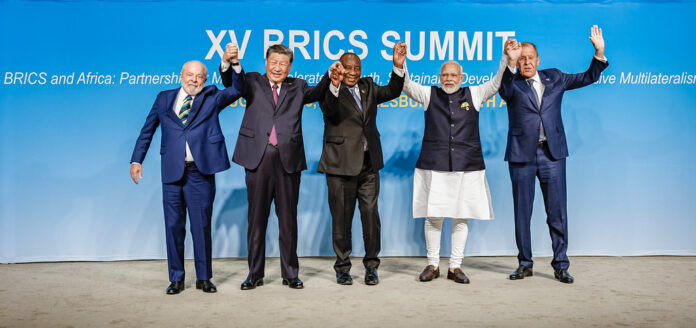
About the BRICS summit
“… Since we are speaking of colonial policy in the epoch, of capitalist imperialism, it must be observed that finance capital and its corresponding foreign policy, which reduces itself to the struggle of the Great Powers for the economic and political division of the world, give rise to a number of transitional forms of state dependence. Typical of this epoch is not only… colonies, but also the diverse forms of dependent countries which, officially, are politically independent, but in fact, are enmeshed in the net of financial and diplomatic dependence….” Lenin, Ibid, p. 101.
Before the August summit, the BRICS group already accounted for more than 42% of the world’s population, 30% of the territory, 25% of GDP and 18% of world trade. Of the twenty countries that have formally applied to join the group and the 40 or so that have shown interest in the project (even Macron’s France has “fooled around” with the idea), Saudi Arabia, Argentina, Egypt, the United Arab Emirates, Ethiopia and Iran have been formally invited to join the bloc since January 2024. With this, the BRICS economies would add up to 36.38% of global GDP compared to the 30.39% represented by the G7 countries (Germany, Canada, the United States, Japan, France, the United Kingdom and Italy) and would have 45% of world oil production and a more than considerable weight in the extraction industry of iron, coal and bauxite, not to mention agricultural production (taken from El País, September 24, 2023).
The expansion agreed to at the summit thus represents an undeniable victory for China, which is seeing its geopolitical influence rise: we must not forget that China’s GDP represents about 70% of the total GDP of the BRICS, and Beijing is behind many of the initiatives that these countries are implementing, from the New Silk Roads to the Shanghai-based New Development Bank.
In his speech to the Assembly, Xi Jinping said in Johannesburg: “…The BRICS are a major force in shaping the international landscape… We must contribute to reforming global governance to make it fairer and more equitable, and bring greater positive certainty, stability and energy to the world… We should expand political and security cooperation in order to maintain peace and tranquillity. As a Chinese saying suggests: “Nothing is more beneficial than stability, and nothing more harmful than turmoil”… Human history will not end with a particular civilization or system… The BRICS countries should practice true multilateralism, uphold the UN-centred international system, support and strengthen the multilateral trading system centred in the WTO, and reject attempts to create small circles or exclusive blocs. We must make full use of the role of the New Development Bank, push for reform of the international financial and monetary systems, and increase the representation and voice of the developing countries… China is willing to work with its BRICS partners to pursue the vision of a community with a common future for mankind, to strengthen strategic partnership and deepen cooperation in all fields. As BRICS members, we must face our common challenges with a shared sense of mission, forge a brighter future with a common purpose, and walk the path of modernization together. Taken from Grand Continent.
This is a monument to cynicism, an explicit renunciation of any socialist revolutionary change, (I recommend stopping to think about the intentions expressed in the underlined lines of the speech); a pompous and mellifluous hymn to “universal justice” incompatible with the imperialist practice of capitalist states.
For months, the apologists of the “new multipolar order” have been spreading the good news of this meeting, focused on two issues that were constantly pointed out as the main objectives of the meeting: the expansion of the group and the proposals for the “de-dollarization” of the world economy.
The first objective, expansion, as I say, has been achieved, although at the cost of increasing the internal contradictions of a very heterogeneous group in which the major powers seek their own interest in association.*(1) It is worth referring again to Lenin’s text, which stated: “… We see plainly here how private and state monopolies are interwoven in the age of finance capital; how both are but separate links in the imperialist struggle between the big monopolists for the division of the world….” Ibid., pp. 35-36.
For any aware analyst, it is surprising that states such as Iran and Saudi Arabia, which have been at loggerheads for decades for socio-political reasons (Iran is a declared enemy of the US and Saudi Arabia is one of its staunchest allies), economic reasons (both are among the main oil producers) and even religious reasons (one is the head of Shiite and the other of Sunni Islamism) are in the same forum where it is a matter of forging alliances and common agreements between the allies… It seems that the speed at which events are unfolding in periods of imperialist crisis is helping capitalist leaders to be extremely “creative”.
It is true that since the 1990s, China has gradually become Saudi Arabia’s top trading partner: China’s exports to Saudi Arabia have increased at an average of 15.3% per year, rising from $905 million in 1995 to $31.8 billion in 2020. Meanwhile, during the same period, China’s imports from Saudi Arabia rose from $393 million to $33.4 billion, an average annual increase of 19.4%. Taken from De conversation March 2023.
But, the point is that the BRICS countries have their own interests and they are going to work for them. This is how the newspaper Expansión explained it in the case of Saudi Arabia last September: “… the loss of influence of the United States in the Middle East has led the Arab monarchy to seek more powerful allies and has turned to Russia and, above all, to China. It is no accident that the understanding between Saudi Arabia and Iran was signed in Beijing. Xi Jinping’s government has the ability to control Tehran, because the Iranian regime depends on the economic support supplied by the Asian giant… Moreover, China’s mediation sends a serious message to Washington. This reminds it that if it relinquishes its influence in the Middle East, other powers will take its place… Its petrodollars are serving to soften the criticism that its deficient relationship with human rights still provokes…”*(2)
This shift does not prevent the Arab theocratic monarchy from being two-faced in its eagerness to find its own way to investments of its financial oligarchy (the recent purchase of 9.9% of Telefónica’s shares and the rain of “petrodollars” in the world of soccer have shown a practice that reaches many other areas).
This was noted by The Wall Street Journal last month: “The U.S. and Saudi Arabia are talking about a possible alliance to obtain metals in Africa that are key to their respective energy transitions… Saudi Arabia is considering investing $15,000 million in mining assets on the continent, in countries such as the Democratic Republic of Congo, Guinea and Namibia… Although the details have not been finalized, a possible deal between Washington and Riyadh would mean that certain U.S. companies would have the rights to buy some of the production of those Saudi-owned assets. That way Saudi Arabia would help the U.S. gain positions with respect to China in the race to develop electric vehicles, which require cobalt, lithium and other metals to make batteries.”
The same can be said of India; A member of the BRICS from the beginning, it has a common border with China, which in 1962 led to a short war between the two countries; they are the two most populous countries in the world and India is running to replace China as the engine of global growth… Prime Minister Modi predicts that India will reach the level of a developed country by 2047, but, today, it is a giant with feet of clay because its disparities are immense: its development is not enough to absorb the 12 million young people who enter the labour market each year. It continues to be a rural country with a very low level of income. in which agriculture employs 44% of the population and contributes only 15% of GDP. Taken from El Economista, September 24, 2023.
That is why the representatives of this state, firm supporters of monopoly capital, are also being two-faced: a few days after the BRICS summit, India presided over the G20 as host, a summit that Jinping would not attend. There, the Indian prime minister made all kinds of diplomatic ruses to touch upon all the issues in conflict, without saying anything, in the final communiqué, leaving all the imperialist leaders satisfied by the false image of peace and understanding that he conveyed “despite the differences”. Everyone happily congratulated each other, acknowledging that Narendra Modi and his diplomats had achieved the goal of becoming the axis of international geopolitics.
On more practical terms, coinciding with the G20 summit, the US, the European Union, India and Saudi Arabia announced the agreement on a mega-project of railways, ports and energy connections that aim to be an alternative to China’s Silk Road. The president of the European Commission, enraptured, described the project as “historic”; Narendra Modi said it was “unprecedented”. As we can see, the enlargement of the BRICS has only increased the internal contradictions of the group.
With regard to the second objective, the agreement has been much weaker, limiting itself to recommending payment with national currencies in purchases between partners, something that was already a common practice. This is especially convenient for powers such as Russia, which faces harsh sanctions from Western powers, to be able to trade with other countries without using or pegging their currency to the dollar. However, each country’s confidence in its partners’ currency is limited. And China doesn’t seem to have any particular interest in it.
The fact that the dollar is the world’s reserve currency means that it is used to setting the price of all commodities, such as oil. The U.S. Council on Foreign Relations, in its report on “The Future of Dollar Hegemony” states: “Nearly 60% of the world’s foreign exchange reserves are held in dollars, with the euro a distant second at around 20%. About 90% of transactions in foreign exchange markets are invoiced in dollars, as is half of global trade. That is, the dollarization of the world capitalist economy is key to U.S. dominance of the global economy, since the U.S. Federal Reserve controls the supply of U.S. dollars and is therefore in fact the world’s central bank. Taken from “The Crisis Observatory”
As of today, about 45% of all global payments made through SWIFT were made in US dollars, while 32% were made in euros. Only 2.3% of SWIFT transactions were made in yuan. Similarly, in the fourth quarter of 2022, the dollar accounted for 54% of the world’s foreign exchange reserves, according to IMF data. The euro accounted for 20% of reserves, while the yuan accounted for only 2.5% of reserves. In fact, in August 2018, China was the largest holder of dollars in its foreign exchange reserves, with $3.08 trillion.
So the sharp fall of the dollar in the economic relations between the imperialist countries would harm the rest of the economies, including those that are part of the BRICS and in particular China. On the other hand, the control of the public accounts of some of the countries that will join the group as of next January is not very edifying and as a consequence their currencies have depreciated greatly against the dollar: 98% for the Argentine peso; 90% for the Iranian rial; 78% for the Egyptian pound, and 55% for the Brazilian real. With this situation it is very difficult to build a common currency. In short, de-dollarization will be a slower process than the social chauvinists anticipate.
On the BRICS and Africa. The Johannesburg summit, which was attended by representatives of 60 countries, was held under the theme: “BRICS and Africa: Partnership for Mutually Accelerated Growth, Sustainable Development and Inclusive Multilateralism”. Behind this “exuberant” semantics, so much to the liking of diplomatic language, there is a very different reality of financial domination over the economies of the African countries in contention between the “Western” imperialist powers (especially France and the United States) and the new “Eastern benefactor”.
For years, taking advantage of the justified weariness of the African peoples with the European and Yankee exploiters, China with its financial investments and Russia using its military “advice”, the sale of arms and even the direct intervention of private military forces, have advanced positions on the African continent. They are investing in infrastructures that facilitate the entry of their products, take advantage of the lower cost of labour and the legal and administrative facilities of the States in the area to set up “mixed” enterprises; obtain raw materials (in particular, rare metals, gold, etc.) on advantageous terms. They are gaining positions in the geopolitical war waged with their imperialist rivals (the African continent, for example, accounts for 54 seats in the UN General Assembly) and bridgeheads for the advance of their troops in the event of conflict. In the relationship between the imperialist powers and the dominated countries there is anything but internationalism or altruism.*(3)
This reality to which the social chauvinists are absolutely immune is not something new; it is the consequence of an essential tendency in the capitalist mode of production in its last, imperialist phase. As early as 1916, Lenin pointed out: “… The export of capital affects and greatly accelerates the development of capitalism in those countries to which it is exported… the utilization of “connections” for profitable transactions takes the place of competition on the open market. The most usual thing is to stipulate that part of the loan that is granted shall be spent on purchases in the creditor country, particularly on orders for war materials, or for ships, etc… The export of capital abroad thus becomes a means for encouraging the export of commodities….” Lenin, Ibid., pp. 76-77.
Why Africa? In recent years, the line of inter-imperialist confrontation has shifted towards Africa and the Indo-Pacific region (in the Pacific there are constant clashes between China and the US, Japan and other “Western” imperialist powers – the AUKUS, a military alliance explicitly aimed against China was recently formed – particularly on account of the status of Taiwan, the island whose sovereignty China has claimed since the end of its civil war).
That is to say, in the Indo-Pacific there are already great powers (China, India, Japan, Australia, etc.) and therefore “equal-to-equal” relations prevail there; but Africa, however, is again a territory “under contention” for the access of imperialist finance capital.
In Africa, between 1978 to 2017, China’s trade increased by more than 200 times. Today, Chinese investment in the African continent amounts to more than $100 billion US, and about 3100 Chinese companies from various sectors have invested there. It is clear that this investment is connected to the competition and access to the raw materials and natural resources that China needs to sustain its economic growth. Infolibre noted in August 2023: “China’s trade volume with Africa is $282 billion, $72 billion for the U.S. and only $18 billion for Russia. Of course China is in the best position to say that it is taking over Africa. One in three major infrastructure projects is being built by Chinese companies and one in five is financed by Chinese banks. Beijing has taken the place left by the West, which was hesitant about financing these projects… It is true, in any case, that Beijing obtains certain ‘marginal’ benefits. For example, some maintenance contracts can extend up to 99 years and certain funded projects involve the exclusive use of Chinese workers, although some African governments require quotas for local workers.”
In the same vein, the digital magazine “Idees” pointed out the following in 2022: “China’s influence on the African political economy is significant on many levels. It is the first trading partner and also one of the main investors, especially in infrastructure. On the other hand, the commitments made by the institutions of the Asian country have a clear long-term vision. On the Chinese side, the need to forge strategic alliances with other developing countries makes its presence on the African continent solid and lasting… Despite this, some imbalances are observable. First, the pattern of trade is reproducing the classic pattern whereby African countries essentially export raw materials and import manufactured goods. Secondly, there are risks of over-indebtedness, which have been accentuated by the COVID-19 pandemic. Although the policy of ad hoc debt forgiveness and restructuring by the Chinese authorities has prevented major default crises, we will have to be vigilant about this issue…”
In other words, an open war has been going on in Africa for years. It is not only NATO that is deploying its strength on the African continent in support of the Western powers. In the same way that Russia has military-technical cooperation agreements with 40 African countries, China formed the First China-Africa Forum on Security and Defense in 2018 and since 2017 has had its first naval base abroad, in Djibouti, a strategic country located in a maritime strait towards the Suez Canal, through which 25% of world exports navigate, mostly oil.
One of the bloodiest examples of the military occupation by the imperialists and their interference in the internal affairs of African countries is that of Libya; once one of the regional powers that, after NATO’s aggression in 2011*(4), is today a country divided into two states controlled respectively by puppet governments of Western imperialism (the Western sector) and Russian imperialism (the Eastern). The recent flooding of the city of Derna, which has caused more than 11,000 deaths and thousands of disappearances, has proven the consequences of the inter-imperialist struggle in Africa. *(5)
Is this altruism? Of course not. The report of our Enlarged CC of April of last year included the following comment that appeared on the “Investing.com” website: “At the period of colonial rule, the appropriation of raw materials was quite simple. A place on earth was conquered by force of arms, the population was enslaved, and coveted raw materials were sent home. Today things are similar, but not as obvious. The former colonies were destroyed after the departure of their occupants. In order for people to be able to work, everything had to be rebuilt, which was not possible without money… The banks of the colonial masters came on the scene and, out of sheer charity, gave countries capital resources to enable the extraction of raw materials, which were then exported. What the slave masters did with their whips works in a (capitalist) society through debts and interest… Everything went well at first, but the market is now so oversaturated with credit that this system is visibly heading towards an abyss that some colleagues equate with the end of the world. It is getting harder and harder to create growth and meet interest payments.” That is, after the good words about “Mutually accelerated growth, sustainable development and inclusive multilateralism” we find only the same financial occupation of the dependent countries, the same objectives of domination.
The inter-imperialist war is above all an economic war without concessions. To advance its positions, China has been resorting to offering “selfless aid” for years that bind countries to the ” debt noose” (6) and they turn them in the direction marked by the one who controls the rope. In exchange, it obtains as loot the control of the raw materials, labour and “geostrategic” advantages for its armed forces, in anticipation of open confrontations. This is nothing that the empires that preceded them in Africa: England, the USA, France, etc. have not done before and continue to do. In the end, as Lenin said: “The creditor is more firmly attached to the debtor than the seller is to the buyer.” Ibid. p. 122.
On the Social Chauvinists
Last September 11, an article was published in Mundo Obrero, the organ of the PCE, signed by its chair José Luis Centella with the title: “The influence of the BRICS summit on the process of reshaping the international order” in which the same social chauvinist position is defended as that of other forces that emerged from the long process of decomposition of Carrillo-type revisionism that today fiercely define themselves as communist and, on other issues related to national politics, virulently attack the reformism of the PCE.
The article as a whole is a defence of the “new order” promoted by China and Russia and a priceless example of the degree of surrender which revisionism has reached in its eagerness to embellish capitalism and proclaim its renunciation of the revolution.
The author does not seem to be aware of the immense contradiction involved in the defence of the bloc whose formation is precisely linked to this body, BRICS, based on which China aspires to advance in the contention for hegemony with the United States, and the objective fact that his party, the PCE, defends and participates in the policy of the Spanish government. It is directly involved in all those decisions taken by Western imperialism led by the Yankee power: involvement in the war in Ukraine on its side against Russia, active participation in NATO, including the sending of weapons and troops to various conflicts in which the interests of the Western imperialist powers are involved, the increase in the Spanish military budget, etc.*(7)
When J. L. Centella speaks of the objectives set out at the BRICS summit, his language reaches the levels of “political lyricism” of the Chinese president in his speech at the Johannesburg summit. In the first point he states: “the BRICS approach is one of building a multilateral system that must be based on a truly open and multilateral trading system that is transparent, fair, inclusive and equitable, non-discriminatory, based on clear and transparent rules that ensure mutual benefit”.
And, in assessing the initiatives that were discussed in order to advance a new framework for international relations and the global security model, J. L. Centella forgets any notion of dialectics in order to state: “The construction of a New International Order must put an end to a centralism of the West when it comes to understanding life and assume that the history of humanity did not begin, nor will it end in a single civilization, so it is necessary to defend a peaceful coexistence and a coexistence between different peoples, different cultures...”.
The author completely ignores not only the class struggle, but its very existence. For him, contradictions are cultural and civilizational; he is silent about the mode of production that conditions life and relations between countries, and within them between the different classes. He talks about the problems faced by countries as if there were no classes there either, as if the various African governments and regimes defended “their nation”, as if there were no exploitation in Africa. This is tantamount to justifying regimes as rotten as that of Egypt or Morocco.
After so much pompous talk, an equally anti-Marxist conclusion had to be reached: “Therefore, despite hailing the advances, one cannot claim victory. The enemy is powerful and is determined to use all the resources at its disposal to achieve its objectives, so it is necessary to combine the advances that multilateralism is making at the institutional, political and economic levels, with achieving a greater capacity for response and popular mobilization in defence of the proposals for reforms of international institutions that are proposed by the BRICS. Because without popular pressure, the bloc that has been hegemonic until now is not willing to give up its privileges in favour of building an international community that does not have hegemonic centers of power, but that has multilateral relations of mutual benefit. To this end, it is necessary to collectively build a plan that transforms analyses and proposals into concrete actions so that they are really effective and everything is documented in the institutional actions of governments.”
All of this, to end up demanding the action of the peoples, not to advance in their liberation, but to change masters. This is what the social chauvinists are putting forward: “In this regard, it should be considered how to take advantage of existing areas of political and social relations in order to elaborate and, above all, carry out, what we can call a great consensus in defence of the planet, with the key being citizen mobilization that forms the broadest and most plural alliance of governments, peoples, social, political and trade union organizations that allows us to accumulate forces to break the imperialist strategy of leading us into a new Cold War fail and allows us to build a multilateral world that ensures a future of peace and progress for humanity in harmony with nature”. (my emphases)
Lenin criticized the positions of the social chauvinists of his era who concealed the character of capitalism and its true essence from the eyes of the workers, creating the false illusion of a world at peace, without contradictions, in which the different powers coexisted with each other in harmony, without conflicts. He did so in these terms: “From the purely economic point of view,” writes Kautsky, “it is not impossible that capitalism will yet go through a new phase, that of the extension of the policy of the cartels to foreign policy, the phase of ultraimperialism.” This is, Lenin added, “superimperialism, a union of all imperialisms of the whole world and not struggles among them, a phase when wars shall cease under capitalism, a phase of ‘the joint exploitation of the world by internationally united finance capital.’… Kautsky’s utterly meaningless talk about ultraimperialism encourages, among other things, that profoundly mistaken idea which only brings grist to the mill of the apologists of imperialism, viz., that the rule of finance capital lessens the unevenness and contradictions inherent in world economy, whereas in reality it increases them...” Lenin, Ibid., pp. 112-113.
History has come to fully substantiate the theses defended by Lenin. In the same way in domestic politics the revisionists have tried to reconcile the possibility of maintaining the achievements of the working class and advancing democracy, on the basis of and within the limits of the Liberal State, or, as in Spain, a State tailored to the interests of an oligarchy that emerged during and linked by a thousand ties to the institutions of the Franco dictatorship. As far as international politics is concerned, they weaken the struggle against imperialism by creating a false illusion of the possibility of overcoming the capitalist system without fighting it, and by claiming that in this imperialist stage it is possible to temper the contradictions between the bourgeois states and to achieve a just and equitable peace between them, without putting an end in a revolutionary way to a system that is behind these contradictions. These are nothing but the expression of the tendency of the capitalist system towards crisis, confrontation and war in the capitalist mode of production in its imperialist phase.
Revisionists and opportunists have been supporting all kinds of irrational theories that pretend to supersede the Marxist analysis and to present capitalist China and Putin’s Russia as states legitimately interested in promoting the peaceful development of the world economy and the well-being of the peoples. They see their interference in the politics of other nations as an “altruistic” if not “internationalist” attitude; they share the mystical and nationalist analysis of imperialist leaders such as Putin or Jinping on alleged reasons of racial identity, a shared imperial past, national security, etc., to justify the imposition of vital spaces, areas of influence and rigid borders against the imperialist competitor.
They systematically forget what Lenin said in his work, and subsequent history has irrefutably confirmed: “The capitalists divide the world, not out of any particular malice, but because the degree of concentration which has been reached forces them to adopt this method in order to obtain profits. And they divide it ‘in proportion to capital,’ ‘in proportion to strength,’ because there cannot be any other method of division under commodity production and capitalism. But strength varies with the degree of economic and political development…. To substitute the question of the form of the struggle and agreements (today peaceful, tomorrow warlike, the next day warlike again) for the question of the substance of the struggle and agreements between capitalist combines is to sink to the role of a sophist. The epoch of the latest stage of capitalism shows us that certain relations between capitalist combines grow up, based on the economic division of the world; while parallel and in connection with it, certain relations grow up between political combines, between states, on the basis of the territorial division of the world, of the struggle for colonies, of the “struggle for economic territory.”
“. Lenin, Ibid., pp. 88-89.
Nothing new, nothing that humanity did not experience when the ideological degeneration of social democracy, went over with weapons and baggage to the camp of reaction and class collaboration, justified the parasitic work of its financial oligarchy by passing off its ruthless colonial exploitation as “good” imperialism, and the rancid nationalism that justified its militarism based on past imperial greatness as necessary to ensure peace in the face of the aggressiveness of its competitor. That betrayal gave way to the first bloodbath in Europe, the First World War.
In conclusion, the weakening of the U.S. as a hegemonic power is advancing. Despite its indisputable military power (its enormous military spending, more than $800,000 million a year, doubles that of the next country in spending), the Yankee economy is sinking into a spiral of production crisis, debt growth, etc. that it cannot solve despite the constant intervention of the capitalist state to save itself from the crash that is gripping its economy.
Also advancing is the formation of a new pole that, despite its growing internal contradictions, can bring together in a future hostile bloc led by China the states that today are subject to the noose of Yankee imperialism. Both processes should be self-evident to the eyes of an attentive person.
Today, the objective data do not allow us to come to a final conclusion about processes that are subject to the influence of factors whose determination will ultimately depend on the interests of the different sectors of the international oligarchy in a world in crisis that is entering more and more rapidly into an economic storm that is affecting the whole of the imperialist economy. It will depend above all on the working class regaining its strength, on communists helping to orient the future struggles of the proletariat by reinforcing internationalism and being implacable towards ideologies that confuse the peoples by denying the need to fight for clear class objectives, to end exploitation, destruction and war.
In any case, the question for communists is whether this shift towards a “multipolar” world portrayed by the social chauvinists represents an advance towards stability and peace among nations and peoples, or a mere temporary state within the tendency of capital in its imperialist phase towards confrontation; that is, the confirmation of the theses of the great proletarian leader, Lenin, who recalled: “… Certain bourgeois writers (whom K. Kautsky, who has completely abandoned the Marxist position… has now joined) have expressed the opinion that international cartels, being one of the most striking expressions of the internationalization of capital, give the hope of peace among nations under capitalism…. the forms of the struggle may and do constantly change in accordance with varying, relatively particular and temporary causes, but the substance of the struggle, its class content, positively cannot change while classes exist….” Ibid., p. 88.
In view of the facts, it is clear that communists cannot be propagandists of any “multipolar world” governed by the laws of finance capital. To do so is to lie and betray the revolution; To pretend that capitalism can overcome its tendency towards crisis and confrontation is to embellish exploitation, misery and war, as well as being an attack on reason.
*(1). After Milei’s victory in the elections, last January Argentina announced its renunciation of integration into the BRICS.
*(2). In 2019, a U.S. intelligence report implicated Saudi Arabia’s Crown Prince and current Prime Minister, Mohammed bin Salman, in the 2018 murder of journalist Jamal Khashoggi. Biden, after promising to make Saudi Arabia “a pariah state”, granted him immunity in 2022 as he considered him “unimpeachable” due to his status as Prime Minister.
*(3). Africa has a debt of $153,000 million with China, which between 2000 and 2020 granted 1143 loans to governments on that continent, according to data from John Hopkins University.
*(4). General Julio Rodríguez, at that time Chief of the Defense Staff and head of operational manager of the Spanish Armed Forces, was then part of the Spanish military centre in the attack on that country, and is now responsible for Podemos’ Think Tank
*(5). The lack of a viable centralized state and the consequent lack of coordination was the ultimate cause of the lack of maintenance of the two dams, whose destruction caused the avalanche that destroyed at least a quarter of the city.
*(6). The U.S. cynically complains that China’s actions imply a “debt trap” for Africa because, it claims, Beijing offers loans for expensive infrastructure projects and when a certain country cannot repay the loan, China takes control of its strategic assets… In short, the thief knows perfectly well how his colleagues manage to break into other people’s houses, because he has done it before.
Regarding the so-called “debt noose” and its political use to control places in dependent countries, it should be said that from the beginning it has been part of the “modus operandi” of imperialism, including that of China. An example: The port of Hambantota in Sri Lanka was built with a $1.1 billion Chinese loan and turned out to be a commercial failure… In 2017, it was placed in Beijing’s hands with a 99-year lease agreement, following the government of that country’s troubles in paying its debts. Since then, there have been several talks of the possibility that China might want to use it to patrol the Indian Ocean.
This is how the Chinese embassy in Panama justified the matter: “Here are the facts—true, not fictitious... Sri Lanka faced (and continues to face) a debt crisis. It has taken significant amounts of loans from China in recent years and in 2017 it agreed to lease the port of Hambantota to China for 99 years in a debt-for-equity swap, on the condition that it could not be used for military purposes… But it is a myth that the port was ‘ceded’ to China—to begin with, the concept of cession does not apply since it is a lease arrangement under which Sri Lanka always has the right to suspend the contract and regain the title to the port in accordance with the procedures and terms agreed upon by the contracting parties, (that is, if you pay), because Sri Lanka had trouble repaying Chinese loans.
*(7). This cynicism is reminiscent of the “Marxism” of the famous comedian Groucho Marx and his acquaintance: “these are my principles… If you don’t like them, I have others.” But it is simply part of the mode of operations of revisionist opportunism: it is a matter of casting nets on both sides to see what is caught.