This article was published in Unity & Struggle No.44, March 2022
Dorte Grenaa, Workers’ Communist Party, APK
The pandemic has revealed to such an extent, that the capitalist system cannot ensure the health of the people and the working class, but that health under capitalism is a commodity that is bought and sold and a goal for profit.
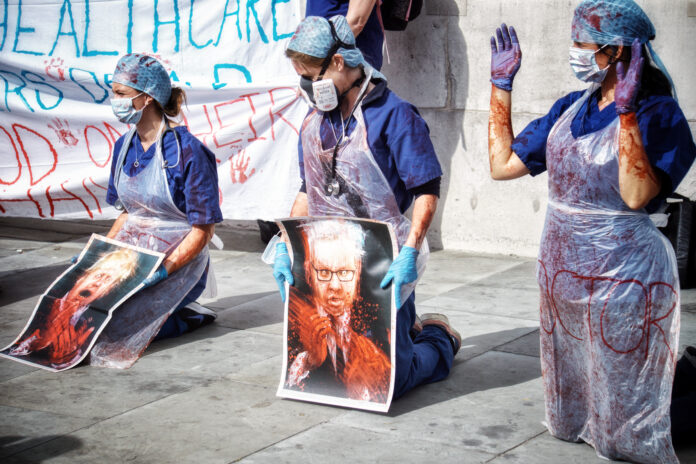
In many countries, healthcare workers have been on strike, carried out actions and protested against the increasingly high-pressure conditions around working hours, working conditions, wages, cuts in staff and equipment – both in the private and public health services. In Denmark there was a national strike of the nurses last year, 2021. First, there was a legal strike organized by the trade union leadership in connection with collective labour – bargaining – that ended with the Social Democratic government intervening in favour of the state as employer and subsequently there were several so-called illegal strikes and stoppages in rotation from hospital to hospital around the country, organized by the health workers themselves.
For many years, the state and government have cut budgets and staff, privatized, denied women – who make up the majority – equal pay, and worsened working conditions to the point where a great many leave the health occupations and fewer new ones are trained and educated.
It is not only in Denmark that there is a catastrophic shortage of employees and professionally competent staff in the public health-care, education, and social sectors. It is the same situation in the rest of Europe – on other continents, indeed on a global scale.
Market conditions mean that both private companies in the health industry and the public health sector, which are now running on market principles, are doing everything possible to keep their costs as low as possible. Keep wages down, push efficiency and lower quality, fewer employees for more tasks and whatever else can lower the cost of labour.
One of the solutions for the richer imperialist countries is to import cheaper labour from poorer countries, either as a permanent solution or to cover temporary fluctuations in how large the state wants the number of health professionals to be.
More recruitment of cheaper foreign health workers as a labour force is one of the focal points of Danish government policy.
From a capitalist and employer point of view, it is pure logic. Health workers have become a global commodity that can be bought cheaper in poorer countries. It is pure capitalist win-win: the salary level can be kept low, and at the same time money can be made from a situation with shortage of staff. Capitalist exploitation of labour is increasing, and imperialist exploitation of the depended countries is increasing by making them pay for the education of health workers prior to migration.
The global imperialist health industry has put trade with health workers into system. Large international recruitment companies have been established for health professionals – doctors, nurses, caregivers, midwives. These companies ensure that all the stages of this trade in health workers’ labour, imports and exports, agreements and contracts with the States concerned are concluded. So just as rich countries like Denmark trade in poor Filipino women who, under the guise of au-pair girls, are underpaid domestic workers and nannies for the wealthy or work as underpaid maids in hotels, so are health professionals traded.
Since the 1990s, private capitalists have been able to suck a huge amount of capital and profit out of privatisation and the dismantling of public health and welfare systems. Not least in Eastern Europe and the Nordic countries, where these were quite developed, with major consequences for the working class and the people. This has created the conditions of a global healthcare industry under market conditions. In Europe, the construction and expansion of the European Union of the big monopolies, EU, has been boosted by the establishment of “the free movement of labour” throughout the EU’s internal market. In Capitalist economics the money flows into the sectors where profits are highest and not where it is most needed in society, or what would benefit public health or create long-term social solutions, which would be the case in a socialist society.
Transnational recruitment companies
There are several multinational care chains, hospital, and other health chains, which also operate in Denmark as an obvious health industry worldwide. There are groups such as Aetna International, which offers governments help in the health service to achieve their financial goals, get more for health dollars, increase operational efficiency, and increase employee efficiency. This specific company, as an example, is operating in Europe, Asia Pacific (Singapore, Hongkong, China, Thailand, Indonesia, Vietnam, and the Philippines), Qatar and Dubai in the Middle East and in the United States.
And then there are the recruitment companies – the link between migrant health workers in their home country and the employers in the country that imports them.
Health professionals must be skilled and licensed, which is why their recruitment is more complex and systematised than in the case of unskilled labour. Recruiters function as initial clearing houses for hospitals by verifying that candidates meet the minimum employment requirements. Each hospital system has specific recruitment procedures that recruitment companies know how to navigate. They also negotiate placement fees and supplement their income by selling other services that can make the trade more flexible. The companies often cooperate with state and public authorities, and in countries such as the Nordic ones with the nurses’ trade unions.
Under imperialism, the migration patterns of a global labour force are not only spontaneous networks of global labour cycles, but also negotiated chains of transnational labour.
From Eastern to Western Europe and on to the Middle East
Nurses are one of the largest groups of trained, educated migrant workers worldwide.
When the revisionist regimes in Eastern Europe collapsed in the late 1980s, one of the consequences was that the former public systems such as the health system were privatized on a wide scale and bought up by Western companies that just withdrew the money from the country. Another consequence was mass unemployment and falling living conditions, despite all the lies and promises of capitalism. This made a chain of cheaper nurses from the former East Germany into the West German hospitals and yet another chain of West German nurses into Denmark in the 1990s. At the same time, the was a large flow of Swedish nurses to Denmark, due to a massive neoliberal privatisation and reorganisation of the Swedish public health system at that time, which caused high unemployment and deteriorating conditions among Swedish nurses.
As most Eastern European countries joined the EU, imports of health workers into western EU countries were made significantly easier. However, they were still discriminated against in relation to full pay and fixed contracts under the guise of lack of competences, trial periods, training, etc.
Although Romania is one of the five countries from which Denmark imports the most health workers today, the flow from eastern countries is now going less into Western Europe and instead into the Middle East, especially into Saudi Arabia, which is one of the world’s largest importers of health workers. This has led to a shift in the “value of many Eastern European nurses on the market”. Whereas before in Europe they were marketed as the bottom of the chain, as only hardworking and docile, the Czech nurses for example are now being sold as competent, flexible, and adaptable labour to the Middle East.
Danish neo-liberal and Social Democrat politicians are also trying, through new technology, to replace health professionals. Not just with technical equipment but digitization to a point which they call “virtual hospital and treatment courses” where you are treated in your own home via computer.
Denmark – part of the global import chain
The number of applications for authorisation from nurses trained abroad has increased significantly in recent years in Denmark but has been going on since the mid-1990s. Today, these are mainly nurses with training and education from outside the EU/EEA – especially from the Philippines and Iran.
In the 2000s, under the neo-liberal Fogh government, the policy was that Denmark should exploit the “surplus” of nursing workers in the Baltic states. The government’s plan was for the foreign nurses to initially work as social and health assistants, while improving their professional level and learning Danish. Thus a great many nurses from non-EU countries end up doing this both in Denmark and the rest of the EU for years. In addition, the Danish state with usual capitalist logic closed the qualification education in Danish language and hospital and work culture that Copenhagen University College’s Nursing School and the Ministry of Integration previously stood for.
In the 2010s, the Social Democrats pursued the same policy. The Chair of the Danish Regions Health Committee, Ulla Asthman stated at that time: “It is quite deliberate and simply necessary for us to bring the foreign nurses in here in order for us to cope with the recruitment problems of the future.”
The Danish regions and hospitals spend many millions of kroner each year paying global recruitment agencies to import cheaper labour. And so, they spend tax money destined for the Public Health sector and educational sector on the parasitic private intermediaries that the global recruitment and “care and health business chains” have developed into. It was not without reason that Karl Marx called capitalism a rotten and parasitic system that constantly expands with expensive intermediaries.
The consequences of imperialism
The consequences of privatization, marketisation and migrant chains are extensive, not least in the poorest and dependent countries in the world, where the catastrophic shortage of health workers is increasing. Migrant flows as a business are particularly critical in the field of health, not least for those countries that are losing their resources, but also for the people of the countries that receive them. In contrast to be unskilled worker on a construction site or in other so-called service industries, the work culture, the communication in the work of the health sector is of direct importance to the patient and colleagues, whether skilled or unskilled.
The rich imperialist countries are not only draining the dependent countries of health workers, but they are also making poorer countries pay for their education. The fact that the majority of migrant health workers are women also raises the issue that they can no longer take responsibility for caring for children, the elderly and the sick in the family they left behind in their home country, for which they were previously responsible. And all the unpaid women’s work they previously did is not replaced by expanded public welfare and care systems, which has both huge human and social consequences for the people and for society.
At the same time, public care systems in the Nordic countries, with the privatization of neoliberalism, are so eroded that an increasingly number of female labourers are being imported from the poorest countries to fill in the worst gaps for the middle and upper classes. This in turn deepens the social problems of poorer countries. The fact that it is the poorest and the working class who are most affected by deteriorating social and health conditions in both dependent and imperialist countries is clear.
While rich imperialist countries steal and exploit the human and economic resources of the poor and dependent countries for their own benefit, they are competing among themselves for the cheapest, most flexible, and hardest-working labour. This is rotten from start to finish.
When it comes to the health professionals and workers themselves, both migrant workers and the employees of the recipient country are squeezed into a downward spiral, where they are set up to compete against each other over lower wages and worse working conditions.
From the migrant countries, several health worker trade unions have tried to call out the recipient countries about the consequences of this development and called on the trade unions, such as the Danish Nursing Council, DSR, for help to stop the export-import model. However, until now they have had no luck. The policy of the leadership of the DSR is that recruiting foreign nurses is a positive step to address the shortage of nurses; they advocate a “diverse” health service and are working closely with the state and employers on this line.
This calls for and demonstrates to such an extent the need for international solidarity between health workers, in the individual workplace, between national health professionals and professional organizations and trade unions across national borders. This is a common cross-trade struggle in the national health system, but also a common international fight across borders among the workers and employees.
Everywhere, this development demonstrates the need to develop the struggle of public servants and the working class for higher wages and better working conditions into a political struggle directly against those responsible and their neoliberal privatisation policies. And into a struggle for a revolutionary overthrow of the capitalist social system, which produces the deteriorating living conditions of the working class and the people.
Common struggle
For the Communist Party of Labour, APK, it is an important issue both nationally and internationally. The policy of migrant health-worker recruitment as a solution must be rejected and met with demands to ensure higher and equal pay, work, and employment conditions. The consequences of the current policy must specifically be raised in the current discussion on the future and reforms of the Danish public health and care system, which is very much about combating privatization and demanding a strong public health care sector not operating on marked terms.
However, for many health professionals and employees who do not directly belong to the working class or do not see themselves as part of it, there is little doubt that their working conditions, with the marketisation of the public sector, are increasingly similar to those of the working class. The efforts and work to build a common united class struggle and movement with the rest of the working class must be strengthened.
In our platform for “The work and tasks of the Party in the workplaces and in trade unions”, APK states, among other things, that: “The solidarity of the working class must always be specifically involved, developed, and strengthened in order to use the common strength of the class. By extending the economic struggle to a political struggle with common demands on those responsible, unity and solidarity can be developed and unfolded. Local and individual negotiations and ‘free-choice’ arrangements make the worker feel alone and isolated, whereas the collective strength of the working class and public servants is the way forward …
“The international solidarity of the working class will always be at the heart of the struggle of the working class and the work of its Communist Party. Specifically among the growing number of employees who, though scattered in many countries, work in the same multinational company. And as concrete and active solidarity with the workers’ struggles and the many battles that workers all over the world are facing against the consequences of neoliberal reforms, against capitalist and imperialist exploitation and oppression, wars and the destruction of resources and survival opportunities, and for a socialist future.”
November 2021