This article was published in Unity & Struggle No.45, November 2022
Pablo Miranda
Marxist-Leninist Communist Party of Ecuador – PCMLE
On December 29, 1922, a Conference of Plenipotentiary Delegations of the Socialist Republics of Russia, Transcaucasia, Ukraine and Belarus, with the mandate of the workers and revolutionary governments, approved the Treaty of Creation and the Declaration of the USSR, thus forming the Union of Soviet Socialist Republics. Each of the republics had its own Constitution.
In 1924, the first Constitution of the USSR was approved, the rules, rights and obligations of the Republics of the new Soviet State were established. In that Constitution, while affirming the will to unite in a single State, the right of separation from the USSR was established and that the change of borders could only be carried out with the consent of each Republic.
December of this year, 2022, marks the 100th anniversary of this extraordinary event that gave rise to a new situation, unprecedented in the annals of humanity.
The old tsarist empire, like other empires and states that existed at that time, included in its territories several countries and nations, various nationalities and peoples who endured national oppression, tyranny, the subjugation of their cultures and the exploitation of the workers by the possessing classes of the dominant nation and certain sectors of the landlords and capitalists of the subjugated nations themselves.
The Tsarist empire was branded a “prison-house of nations.” These circumstances were the result of wars of conquest over centuries, which transformed dozens of countries and nations into “part” of Great Russia; the condition of subjugated peoples and nations was the result of the military occupation by the armies of the Tsar.
As a result of the victory of the Bolsheviks in the October Revolution of 1917, the proletariat, in alliance with the peasantry, won power in Tsarist Russia, transformed itself into the ruling class and from that position began the building of a new society. In that process it made significant progress.
The Soviet power freed the productive forces from the hands of feudals and bourgeois, placed them in the hands of the state organization led by the working class, by the dictatorship of the proletariat. It elevated the working class and the peasantry to the condition of the ruling classes and leaders of society of each of the countries, which had been exploited and dominated by the Russian landlords and bourgeoisie for centuries. It expropriated the expropriators, eliminated private ownership of the means of production, solved the problem of employment for the workers of all nations and nationalities. The workers of the city and the countryside worked decisively and voluntarily in the building of the new society; they created wealth in order to transform a backward country into the second industrial power of the time. The dictatorship of the proletariat placed education, health, social and spiritual welfare in the hands of the workers and peoples, destroyed the patriarchal conceptions of women, established full rights and equal conditions between men and women workers.
The Soviet Power placed on an equal footing the social and national organization of all the peoples and nationalities that were part of the great multinational state that constituted the USSR. National oppression, the “Russification” of different countries and regions, ethnic, gender and cultural discrimination were eradicated. National differences and cultural disparities were given special treatment in order to overcome them. The backwardness of the productive forces was brought into correspondence with the development of the centrally planned economy, with the policies of the satisfaction of the needs and rights of the workers.
The Soviet of Nationalities was formed, in which the Soviets of workers and peasants of all the Republics and Autonomous Regions that made up the USSR participated on an equal footing.
The colonial ties, the oppression of the peoples and nations by the ruling classes of Russia were destroyed by the proletariat of Russia, united to the proletariat and peoples of each and every one of the republics and autonomous regions. A new state was born.
In this great multinational state, several dozen nations and more than a hundred nationalities and ethnicities coexisted fraternally. Unified in the process of building the new world, the various nationalities of the USSR established the society of the workers and, simultaneously, gave multifaceted impetus to their own national cultures, to their own identities. The vast majority of nations formed their own republics and the nationalities developed into autonomous regions. This was possible because, in each of the republics, the working class exercised the role of the ruling class and leader of society.
In these circumstances, the national culture, mother tongues and social and material progress developed. The hundreds of peoples that formed the USSR experienced many-sided development. There is no doubt that mistakes were made, that there were deviations, including abuses, by certain officials who assumed nationalist poses and practices, but the fundamental thing was the flourishing of the peoples and nations on an equal footing, in the great task of building the new world.
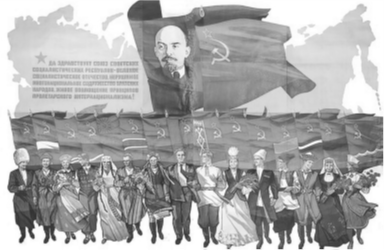 Public education was always carried out in the languages of the nationalities, universities and academies were created for the strengthening of their own cultures, books were published by the millions in all the languages of the vast country that formed the USSR. Several of these languages were on the verge of extinction and were revitalized.
The achievements of the USSR were guaranteed by the dictatorship of the proletariat, by the existence of socialism and the powerful development of the productive forces.
The USSR faced the siege and conspiracy of the internal reactionary forces and of the capitalist world, the pressure of the imperialist countries that struggled to undermine and destroy it and carried out an economic and political siege in order to bury the new world.
In contrast, the working class and the peoples of the world looked with hope and sympathy at the revolutionary process unfolding on the part of the workers and peoples of the USSR under the correct leadership of the Communist Party. The homeland of socialism was recognized on the five continents.
In a few years the great imperialist countries were forced to recognize the existence of the USSR and one by one they established diplomatic relations.
The construction of socialism in the USSR mobilized tens of millions of workers from the city and countryside. The revolution brought down feudal serfdom and capitalist exploitation and, in that scenario, millions of soviet peoples worked decisively and enthusiastically for the building of the new world.
The USSR was established by the Communist Party in each and every nation and republic. The working class rose to the status of ruling class and leader of society in its respective republic and region.
After several decades, after the rise of modern revisionism to power in the leadership of the Communist Party and the Soviet State, the workers and peoples of the USSR lost their rights, saw the new capitalists reborn and with them the restoration of exploitation and oppression.
In 1991, after the rise of Boris Yeltsin to the government, the USSR began the process of disintegration.
The USSR disappeared as such, several of the republics that formed it separated. What was called the Russian Federation was formed.
With this he socialist society that had been built in the USSR collapsed, private ownership of the means of production, factories, banks, mines and land was reconstituted. Powerful capitalist groups were formed and seized political power.
Workers’ rights, stability, living wages, social security, education and health and workers’ housing disappeared.
Sovereignty, the right of nations and nationalities to self-determination were transformed into quarrels and wars; nationalism resurfaced.
Several analysts claim that socialism did not confront and even less solve the national question; according to them it only kept it repressed.
These analyses ignore the essence of the national question grasped and acted upon by the communists and the dictatorship of the proletariat.
From Marx and Engels to Lenin and Stalin the communists linked the national problem to the class struggle. They always considered nationalism as an expression of the interests of the bourgeoisie; they demanded from the working class the assumption of a correct policy in favour of the independence and self-determination of nations without hitching themselves to the chariot of the bourgeoisie and the landlords.
What happened after the October Revolution, the formation and destruction of the USSR affirms these concepts. Depending on which social class leads society and the state, the national question will be dealt with for the benefit of the interests of workers and peoples or for the benefit of the privileges of the capitalists and imperialism. If it is the working class and its party, the different nations and nationalities will live fraternally, on an equal footing; the right of self-determination of the peoples and nations, the right to decide for themselves their own course, shall be fully respected. If the bourgeoisie and imperialism form the ruling classes of society, the interests of capitalists and monopolies will always prevail, the conflicts of nations, nationalities and tribal formations will always be instigated, manipulated by imperialism and its servants.
The nation
Clearly, Marx and Engels did not elaborate the conception of the nation; however, several references to this question cannot be ignored in various works, which became the basis for the most comprehensive analysis of the national problem developed by Lenin and Stalin.
They emphatically pointed out that “the nation is, above all, a strictly political formation that can welcome into its bosom different nationalities and abstracts from them through the concept of citizenship”, which, as is known, is an idea of the bourgeois revolution that became a reality in the framework of the capitalist state.
In the Manifesto of the Communist Party, published in 1848, it is expressly stated that the proletariat in the struggle for its emancipation must establish itself as the ruling class within the framework of its own country.
The Manifesto of the Formation of the International, written by Marx and Engels, called on the working class of Poland to take up the struggle for national independence. Similarly, Marx supported Irish independence and called on the English workers to support the Irish workers in their independence struggle.
In the first decades of the twentieth century, when the workers’ movement was growing and developing in Europe under the slogans of proletarian internationalism and international revolution, various expressions of nationalism appeared; the landlords and the bourgeoisie brandished the slogans of national independence with the aim of safeguarding and expanding their interests and benefits, in order to drag the working class behind their aims. This was a concrete question that could not be avoided by the socialists.
Lenin took a position, in an integral way, for the right of nations and peoples to self-determination, to decide their destinies for themselves, to constitute nation states and even the right to separation.
Lenin was the Leader of the Russian Social Democratic Labor Party and confronted the landlords and the bourgeoisie who ran the vast tsarist empire responsible for the subjugation and oppression of hundreds of peoples and nations. He called on the workers, the peasants of all Russia to rise up against the Tsar and to fight for socialism.
In the context of the debates among socialists, the national question was topical and there were not a few “theorists” and “Marxists” who contradicted Lenin, among them, Rosa Luxemburg with whom a stimulating debate unfolded.
In several writings and works Lenin defended with conviction the right to self-determination of peoples, extending it to separation as another state.
These teachings educated the militants of the Bolshevik Party; they became banners for the workers and peasants of the various nations and peoples of Tsarist Russia; they were the inspiration that led the communists to form the USSR in 1922.
Stalin dealt with the national problem in an early and timely manner; he gave guidelines for the work of the Party.
We owe to Stalin a systematic work on the national question. These teachings were concretized in social practice, in the formation of the USSR, its vicissitudes and problems; they were a guide to deal with the development of nations and nationalities of the Republics and Autonomous Regions that formed the USSR.
Stalin’s definition of the concept of nation serves as the basis for the Communists’ theses on the national question:
“A nation is a historically constituted, stable community of people, formed on the basis of a common language, territory, economic life, and psychological make-up manifested in a common culture.”
The nation rises and takes on a life of its own with the capitalist state. The class of capitalists plays a preponderant role in its formation, but its base of support is made up of the subordinate classes. The body of the nation is made up of the ruling classes and the oppressed classes that have given their consent, that have added their contingent to the great enterprise of its formation. The subordinate classes, involved by the bourgeoisie in the project of the nation, formed a political and military shock brigade, in the troops that won national independence; the ruling classes, the bourgeois were the captains and the beneficiaries, who built the nation-state to preserve and develop their class interests.
The nation encompasses the whole community and has common historical, cultural, psychological, linguistic, economic and territorial features, but it is not a homogeneous entity.
In the various capitalist countries, the nation is divided into antagonistic classes, the bourgeoisie and the proletariat; in the dependent countries, the nation, the society, is also divided into antagonistic classes: on the one hand the bourgeoisie associated with and dependent on imperialism and, on the other, the working classes with the working class as the main protagonist of economic, social and political life. This means that the process of development of nations is marked by the class struggle, by the confrontation of the antagonistic interests of the classes.
The capitalist state constitutes the stage for the continuation of the process of development of the nation. It is a bourgeois nation that includes all social classes: the capitalists and the workers.
The process of the formation of nations is marked by historical vicissitudes. Several human communities were acquiring common features: survival for dozens and hundreds of years in the same environment, in a common territory, living with the same problems and facing them in order to survive, united by the same general interests, of subsistence, expansion, defence, among other aspects. They were creating and nurturing cultural, religious and psychological identities; they gave rise to a common language; later that language reached the levels of literary language. With the development of the productive forces, with the emergence of the market and above all with the advent of industry there was an important impulse; the bourgeoisie assumed the leadership of society and gave the final brushstroke to the emergence of modern nations.
The modern nation is ultimately a product of capitalism. This is not to say that the process of its formation is limited to the capitalist mode of production.
The nation expresses the characteristics of concrete human communities: spiritual and cultural goods, a common history, ideas and customs, myths and legends, art, literature, religion; the unifying literary language; the territory and history of its formation; and the organization of the internal market, of a common economic life established within the framework of State regulations. In reality, the nation is formed in correspondence with the creation of the National State.
In society, the dominant ideas are those belonging to the classes that hold power; national culture is shaped from the ideology, ideas and proposals of the ruling classes. In the capitalist states, the dominant national culture is today a reactionary culture, as decadent as is bourgeois society; because it is subjected to imperialism, it is constantly denationalized. Within this national culture there are, however, spiritual values that have a progressive character, that are the expressions of the classes subordinated by development, that are the manifestations of history that records heroic and important events in the process of the historical formation of the nation, that are the expression in the dominant culture of the ideas and proposals of those below. Beyond that, in every nation-state there are oppressed cultures, those that correspond to the working classes, to the oppressed and dominated classes; this is a culture that is fundamentally progressive, patriotic, revolutionary, although in it there are also present backward, reactionary elements that correspond to the influence of the ruling classes and their ideas, to the weight of the traditions of feudalism. In the multinational states there are also the cultures of oppressed, dominated nationalities, which also, in the main, have a progressive character.
Interculturality
In multinational states, the social relations of production, life and its cultural manifestations, institutions and traditions establish, in fact, links between peoples, nationalities and nations.
These relationships are part of interculturality. This interculturality works independently of the will of the people; it is part of the economic base and superstructure of society. Under capitalism, this interculturality is intertwined with the ideology of the ruling classes, with their economic and cultural interests, with the institutions and legitimacy that maintain that domination; it is, therefore, an interculturality of subjection by the dominant nation of the dominated nations, nationalities and peoples, whether or not they are minorities. It should be considered that there are situations in which the dominant nation is not necessarily the majority nation.
This means that interculturality, in these cases, is one between the dominator and the dominated, ethnic and cultural segregation that is expressed in social, economic and political discrimination. On the part of the dominated peoples, resistance and/or rebellion, insurgence, and the proposal of an interculturality among peers are always raised at different levels. This confrontation is part of the class struggle between the capitalists and the workers, between the bourgeoisie and the proletariat, between the nation and the peoples against imperialism.
The term interculturality is of relatively recent use; according to several authors and political representatives of the bourgeois and petty bourgeois political parties, interculturality must be built starting from the present moment. We maintain that interculturality is of long standing and that the task now is to tear down the foundations of these unjust intercultural relations and build others, in correspondence with the interests of the majority of the population of the nation, nationalities and peoples, made up of the workers of the city and the countryside.
In the multinational states, an intercultural experience is established between the dominant nation and the oppressed nationalities. It is an interculturality in which the interests and privileges of the dominant nation prevail and in which the rights and interests of the dominated nationalities and peoples are subjugated. This is a reality that will not substantially change within the framework of capitalism. For this change to take place, the social revolution of the proletariat, the overthrow of the class domination of the bourgeoisie and imperialism is necessary.
The Epoch of Imperialism and the Struggle
for Social and National Liberation
The rise of capitalism to its highest stage, imperialism posed, for the working class and the peoples, for the proletarian revolutionaries the need and the task of merging the struggle for social revolution with the battles for national liberation.
In all countries the working class faces its direct enemies, the class of capitalists. In the imperialist countries, the capitalists exploit and oppress the workers of their own countries and beyond, they extend their tentacles to billions of workers all over the world. In the dependent countries the working class confronts the bourgeoisie of its own country, which is becoming the support of imperialist domination, which plays the role of securing and defending the domination of the monopolies.
The struggle for the interests and rights of the working class is waged, on a daily basis, in each country and confronts the immediate bosses, the native capitalists and, objectively, the imperialist monopolies.
The strategic objectives of the working class and its party are the elimination of the exploitation and oppression of the capitalists, the liberation from the yoke of imperialism.
Patriotic positions and the struggle for national independence have ceased to be, fundamentally, the slogan of the bourgeoisie and the landlords, as they were in the past. They are unable to fulfil that role. Now their interests and their existence are tied to the links with the imperialist monopolies.
However, there are sections of the bourgeoisie that brandish patriotic slogans with the purpose of dragging the workers and peoples behind them. That role has to do with the renegotiation of dependence and in some cases with the objectives of changing the imperialist master, of leaving the subjection to one imperialist country to shelter under the sphere of another imperialist country. This circumstance can be seen, above all, in Africa and Latin America, where the United States is losing ground, with the approval of sectors of the bourgeoisie to China, which is contending, for now by economic means, for a new redivision of the world.
The struggle for the social revolution of the proletariat in our times places on the agenda the struggle against imperialism, that is, the struggle for national liberation and the breaking of the chains of capitalist exploitation.
The exploitation of the capitalists cannot be fought and eliminated if imperialist domination is not consciously combated and, correspondingly, one cannot fight for national liberation without decisively confronting its partners and servants, the native bourgeoisie.
This means that the party of the proletariat must decisively assume the banners of national liberation, fight consistently to unmask the “patriotic” proposals of sectors of the bourgeoisie and to achieve the leadership of the working class, the peasantry, the other working classes in the struggle against capital and imperialist domination.
Ecuador, September 2022